
Your customers are starting to ask Google longer questions and read an AI answer instead of a list of links. Now that answer can carry ads. Google AI Mode ads are rolling out in India, which means a “Sponsored” result can appear inside or next to the reply your customer reads, usually for commercial searches. The first name a customer sees in that answer is often the one they call. Being visible there is no longer only a paid question; it is part of AI search optimisation for Indian businesses too. This guide explains what Google announced, what it means if you already run ads, and the three things to do if you don’t.
Quick answer: On 28 October 2026 Google announced that ads in AI Mode are scaling to 10 new countries, including India. Sponsored ads can appear within or alongside AI Mode answers, mainly for commercial searches. Advertisers should keep landing pages clear and tracking accurate. Others should complete their Google Business Profile and answer customer questions on their website.
Key takeaways
- Google announced on 28 October 2026 that ads in AI Mode are scaling to India and nine other countries.
- Ads are labelled Sponsored and can appear within or alongside AI answers, mainly for commercial searches.
- Existing Search advertisers may already be eligible, with no separate switch for this placement.
- Advertisers should tighten landing pages, search terms and conversion tracking.
- Non-advertisers should complete their Google Business Profile and answer common questions on their website.
Contents
What did Google announce about ads in AI Mode?
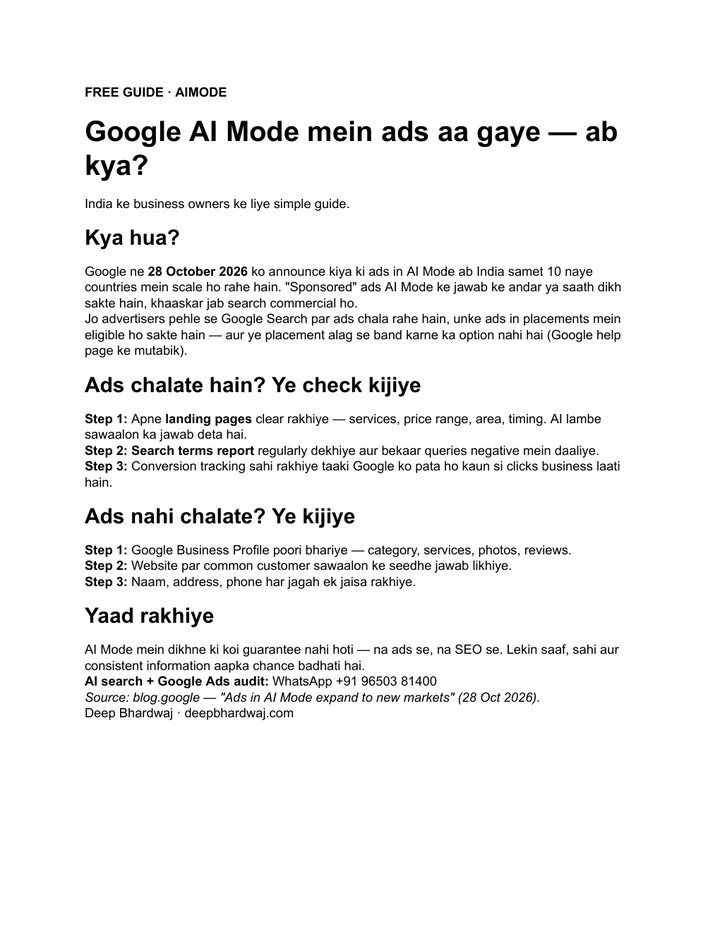
On 28 October 2026, Google announced that ads in AI Mode are scaling to 10 new countries, and India is one of them. Ads carry a “Sponsored” label and can appear within or alongside the AI Mode response, especially when the search is commercial, such as looking for a service or comparing options.
Google’s post, “Ads in AI Mode expand to new markets”, lists Australia, Canada, India, Kenya, Malaysia, New Zealand, Nigeria, Pakistan, the Philippines and Singapore, with Brazil, Mexico and the United Kingdom planned later in the quarter.
AI Mode is Google’s conversational search: people ask long questions and follow-ups and get one written answer. We covered how that changes organic visibility in how to win conversational search in Google AI Mode. The ads announcement adds a paid layer on top.
Why does an ad inside an AI answer matter?
Because the AI answer replaces the list your customer used to scan. In a normal results page they might compare five or six options. In AI Mode they read one reply, and the business named first, whether through an ad or an organic mention, often gets the call. Fewer places to appear means each one counts more.
This continues a trend Indian businesses already feel. More searches end without a click, and AI summaries answer many questions directly. Pages that are clear and specific tend to be the ones these answers draw on, which we explain in why most sites fail to get cited in AI Overviews.
Will your existing Google Ads show in AI Mode?
They may. According to the guide, advertisers already running Google Search ads can be eligible for these placements, and there is no option to switch this placement off separately. So if you run ads today, you may already be showing inside AI answers without changing anything.
Google’s help page on ads in AI-powered experiences in Google Search makes the same point for AI Overviews: you can’t opt out of that placement or target it directly, and those ads are reported as top ads, without a separate report. Plan as if the same budget and the same ads now reach a new kind of result.
| You run Google Search ads | You don’t run ads | |
|---|---|---|
| Where you can appear | Sponsored placement in AI Mode, if eligible | Only in the AI answer itself, through good information |
| What controls it | Your existing campaigns, keywords and landing pages | Your website, Google Business Profile and consistent details |
| First job | Clear landing pages and clean search terms | A complete listing and direct answers on your site |
| Guarantee | None | None |
What should you check if you already run Google Ads?
Three things: make every landing page answer the questions a customer would ask, remove wasted searches with negative keywords, and make sure conversion tracking shows which clicks bring business. AI answers handle longer questions, so pages that state services, prices and areas clearly give the system more to work with.
- Clear landing pages. State your services, price range, area and timings plainly. AI answers long questions, so vague pages lose.
- Search terms report. Review it regularly and add irrelevant searches as negative keywords.
- Conversion tracking. Keep it accurate so Google learns which clicks lead to calls, forms or sales.
None of this is new work, but AI Mode raises the cost of skipping it. If your account has not been reviewed in months, a Google Ads audit and management team can check all three in one pass.
AI Mode mein dikhne ki koi guarantee nahi hoti, na ads se, na SEO se. But clear, correct and consistent information improves your chances.
— Deep Bhardwaj
What should you do if you don’t run ads?
Make your business easy for AI to describe correctly. Complete your Google Business Profile with the right category, services, photos and reviews. Answer common customer questions directly on your website. And keep your name, address and phone number the same everywhere. That is how you appear in the answer itself.
- Fill in your Google Business Profile completely: category, services, photos and reviews.
- Write direct answers to common customer questions on your website.
- Keep name, address and phone identical across your website, listing and directories.
Each step builds on work you may already have started. A complete listing is the core of Google Maps and listing optimisation, and question-led pages are what generative and answer engine optimisation is about. For the listing side, our Google Maps Top 3 workflow walks through it step by step, and building a brand that AI models recommend by name covers mentions beyond your own site.
How can you see what AI Mode shows for your business today?
Search like your customer. Open AI Mode and ask the three questions customers ask you most often, in the words they actually use, including Hinglish. Note which businesses are named, whether any Sponsored results appear, and whether your business is described correctly. Repeat the same questions every month.
Keep the test simple and honest. Use your own city and service, for example “best physiotherapy clinic near me for back pain” or “GST filing charges for a small shop”. Write down the date, the question, the businesses mentioned and any ads shown. Over a few months, this record tells you more than any single screenshot.
If your business never appears, or appears with wrong details, the fix is usually on your own pages: clearer service descriptions, visible prices or ranges, and structured data. Our guide to the schema markup types every site needs for AI search shows which ones help machines read your pages.
What is the next step?
Google AI Mode ads change where the first impression happens, not the basics behind it. If you advertise, check landing pages, search terms and tracking this week. If you don’t, finish your listing and add clear answers to your website. Either way, nothing guarantees a place in AI Mode. Start with a free audit of your website and AI search visibility, or compare monthly SEO packages if you want the organic side handled for you.
Services that help with this
- AI SEO (GEO/AEO): Structure your website so AI answers describe your business correctly.
- Google Ads management: Landing pages, search terms and conversion tracking set up for AI-era search.
- Local SEO: A complete, consistent Google Business Profile that AI and Maps can trust.
TL;DR
- Google announced ads in AI Mode for India and nine more countries on 28 October 2026.
- Existing Search ads may already appear there, with no separate opt-out.
- Advertisers: tighten landing pages, search terms and conversion tracking.
- Non-advertisers: complete your listing and answer customer questions on your website.
Frequently asked questions
What is Google AI Mode?
AI Mode is a conversational search experience in Google. Instead of a list of ten links, the user gets a written answer and can ask follow-up questions in the same thread. It suits longer, more detailed questions, like comparing services or planning a purchase. Businesses can appear in the answer through clear information on their website and listing, and now also through Sponsored ads where eligible.
Do I need a new campaign to show ads in AI Mode?
Based on Google’s current information, no separate campaign is needed. Advertisers already running Search ads may be eligible for AI Mode placements, and there is no separate switch for this placement. That makes your existing keywords, ads and landing pages more important. Review them with AI Mode in mind, especially for longer, commercial questions your customers ask.
Can small businesses in India benefit from AI Mode?
Yes, if their information is clear. AI answers draw on details businesses publish about themselves, so a complete Google Business Profile, a website that answers common questions, and consistent contact details all help. Small businesses often know their customers’ questions better than big brands do, and writing direct answers to those questions is one of the cheapest ways to improve visibility.
How will I know if my ads appeared in AI Mode?
Google does not currently offer a separate report for every AI placement. Its help page on AI Overviews says those ads are counted as top ads without segmented reporting. Watch overall trends instead: impressions, clicks, conversions and the search terms report. If questions in your search terms get longer, AI-style searches are likely reaching your ads.
Is SEO still worth it now that AI Mode shows ads?
Yes. Ads only cover the paid placement, while the AI answer itself is built from information Google trusts. A strong website, a complete listing and consistent details help you appear in that answer without paying per click. Most businesses do best with both: ads for immediate demand, and SEO for long-term visibility that keeps working when the budget is paused.