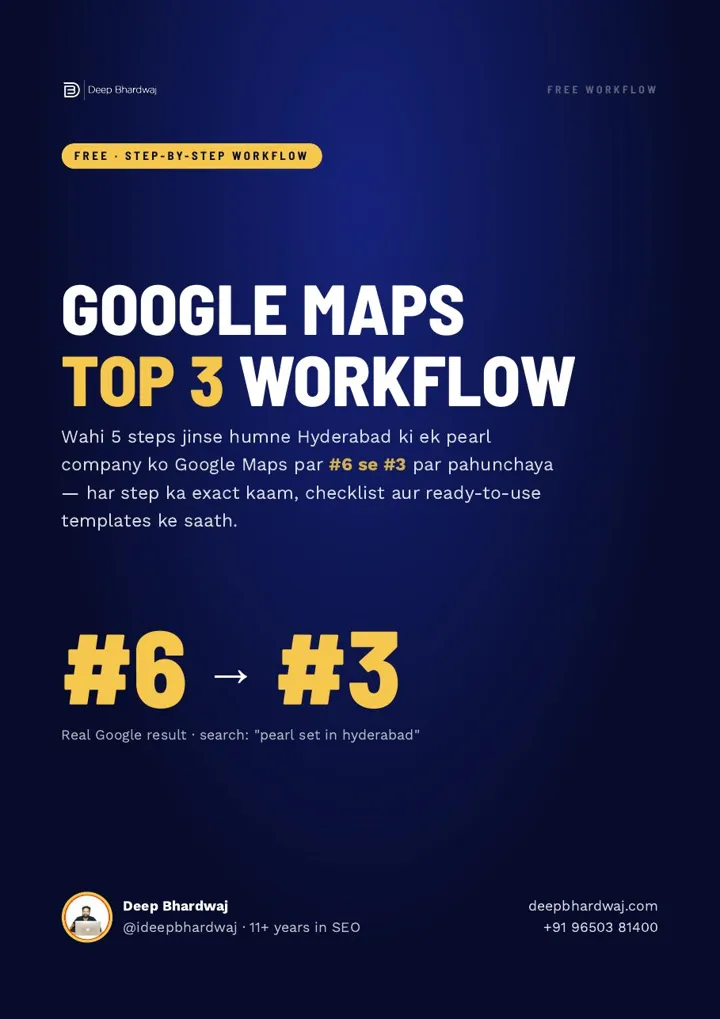

You search for your own business on Google Maps and find three competitors sitting above you, while your listing hides behind “More places”, where most customers never look. If you have been wondering how to rank in the Google Maps Top 3, this page walks you through the same five-step workflow we use in our local SEO services in India. It is the method that moved a Hyderabad pearl jewellery company from #6 to #3 for “pearl set in hyderabad”. Every step is something a business owner can do from a phone, in a few minutes a week, without buying any tool.
Quick answer: Pick the most specific primary category, keep your name, address and phone number identical everywhere, earn a few genuine reviews every week and reply to each one, post weekly with real photos, and check your ranking area by area every two weeks. Most listings start moving within a few weeks; a stable Top 3 spot usually takes a few months.
Key takeaways
- Only three listings show above the normal results; everything else hides behind “More places”.
- Your primary category is the strongest relevance signal, so pick the most specific one the top three share.
- Name, address and phone must match exactly on Google, your website, social profiles and directories.
- A few genuine reviews every week, each answered within 24 hours, beats a one-time review drive.
- Measure with an incognito keyword-plus-city search and a geo-grid check, never a “near me” search from your own shop.
Contents
Why does the Google Maps Top 3 matter so much?
When someone searches for a business with a city or area in the query, Google shows a map with just three listings above the normal results. Everyone else sits behind “More places”, and most people never tap it. For a local business, those three spots decide whether the phone rings.
Maps ranking is not a mystery. Google explains that local results are based mainly on relevance, distance and prominence. You can’t move your shop closer to every customer, but you can build relevance and trust every week.
We used this workflow for a Hyderabad pearl jewellery company, which moved from #6 to #3 for “pearl set in hyderabad”. Our page on SEO for jewellery brands shows how the same thinking carries over to a website.
How do I find my real Google Maps position before I start?
Search your main keyword plus your city in an incognito window, note your position in the map results and take a screenshot. That screenshot is your Day 0. A “near me” search from inside your own shop always looks better than reality, so never judge your ranking that way.
- Search a keyword such as “pearl set in hyderabad” in incognito.
- Save a dated screenshot of your map position.
- Note the category, review count, last review and last post of the three listings above you.
- Confirm your profile is verified, your hours are right and your phone number works.
To go deeper, our 15-minute Google Maps ranking audit reveals the hidden categories and services of every listing above you.
Step 1: How do I choose the right primary category?
Open the listings of the top three businesses for your keyword and note the category under each name. The category they share is usually the right primary one for you. Pick the most specific option, such as “Jewellery store” rather than “Store”, and add two to four secondary categories for work you genuinely do.
After saving, give it one to two weeks. Changing the category again and again sets you back.
Step 2: Why must my name, address and phone match everywhere?
Google cross-checks your business details across the web. If your name, address or phone number (often called NAP) is written differently on different sites, Google trusts your listing less. One exact format, copied everywhere, removes that doubt, and it is one of the cheapest fixes you can make.
- Fix one format: signboard name, one address spelling with pin code, one phone number.
- Copy it to your profile, website footer, Instagram, Facebook and directories, and correct old listings.
Not sure which directories still deserve your time? Read our breakdown of whether Justdial, IndiaMART and Sulekha listings still help SEO.
Step 3: How many new Google reviews do I need each week?
There is no magic number. What matters is a steady flow: a few genuine new reviews every week, and a reply to every review within 24 hours, including the negative ones. That rhythm tells Google and customers your business is active, which a one-time review drive followed by silence never does.
- Turn your review link into a QR code for your counter.
- Send a polite WhatsApp message with the link after every bill, to every customer.
Never buy reviews or offer gifts for them. Google’s policy on fake and incentivised reviews does not allow them, and they can be removed.
Step 4: How often should I post and add photos?
Post once a week and upload two to three real photos every week. An active profile wins over a silent one, and a Google post takes about ten minutes. Pick a fixed day, such as every Monday, and rotate a few simple ideas so you never run out of things to say.
Rotate a new product, an offer, a behind-the-scenes look and an answer to a common question, each with a button such as “Call now”, as Google’s help page on Business Profile posts describes. For photos, show your signboard, interior, team and best products; stock photos don’t build trust.
Step 5: How do I check my ranking area by area?
Use a geo-grid rank check. It shows your position across a map of your city, so you can see where you sit in the Top 3 and where you drop away. You might be #1 right next to your shop and #11 three kilometres away, which a single search never reveals.
- Green spots are Top 3, yellow is 4–7, red is 8 and below.
- For red areas, mention those area names in posts and ask customers from there for reviews.
A helpful page for each area you serve also helps, and our website design team builds pages that match your profile exactly.
What separates Top 3 listings from the ones stuck below?
Usually it is not one big thing but several small habits done every week. The listings above you tend to have a sharper category, consistent details, fresh reviews with replies and regular posts. The table below puts the common mistakes side by side with what Top 3 listings do instead.
| Area | What holds listings back | What Top 3 listings do |
|---|---|---|
| Business name | Keywords stuffed into the name | The exact name on the signboard |
| Category | A vague primary such as “Store” | The most specific category the leaders share |
| Contact details | Different numbers on different sites | One NAP format everywhere |
| Reviews | Fake, incentivised or unanswered | Genuine weekly reviews, each answered |
| Activity | No posts for months, stock photos | A weekly post and real photos |
For the bigger picture, see the Google Business Profile ranking factors that actually move the needle in 2026.
How long does it take to reach the Google Maps Top 3?
Every business, city and level of competition is different. Most listings start moving within a few weeks of steady work, and a stable Top 3 spot usually takes a few months. The free guide includes a week-by-week plan for your first 30 days, so you know exactly what to do each week.
“Ranking 1 din mein nahi badalti. Consistency hi asli secret hai.” (Ranking doesn’t change in a day. Consistency is the real secret.)
— Deep Bhardwaj
For timelines beyond Maps, read how long SEO takes to show results, or ask for a free SEO audit of your website and listing.
What should I do this week?
Do the Day 0 check today, then fix your category and NAP this week. Reviews, posts and area checks become your weekly routine. That is the whole answer to how to rank in the Google Maps Top 3: five simple steps, done every week and measured honestly against your Day 0 screenshot.
The map pack still matters as search changes; we explain why in local SEO after AI Overviews and how small businesses win the map pack. You can also browse our client ranking results.
Services that help with this
- Local SEO services: We run this five-step workflow on your listing every week, with area-wise rank checks and reports.
- Website design: Area pages and consistent contact details on your site that back up your Maps ranking.
- Google Ads: Bring calls from the top of Google while your map ranking builds.
TL;DR
- Only three listings show on the map; that is where local calls come from.
- Fix your primary category and NAP first, then make reviews and posts a weekly habit.
- Measure with incognito and geo-grid checks against a Day 0 screenshot.
- Expect movement in weeks and a stable Top 3 spot in a few months.
Frequently asked questions
Does my business need a website to rank on Google Maps?
You can rank without one, but a website helps. When your site shows the same name, address and phone number as your profile, and has a clear page for each service and area you cover, Google has more evidence that your business is real and relevant. A simple, fast site with those basics is enough to start; it does not need to be large or expensive.
Can a business without a shop front rank on Google Maps?
Yes. Plumbers, home tutors, cleaners and other service-area businesses can hide their address and list the areas they serve instead. The same habits apply: an accurate category, steady reviews and regular posts. Distance from the searcher still matters, so you will usually rank most easily close to your base and need more work, such as reviews from those areas, to show further out.
Why did my Google Maps ranking suddenly drop?
Common reasons are a recent edit to your name, category or address, a competitor becoming more active, reviews being filtered or removed, or a mismatch in your contact details on other sites. Check your profile for unwanted changes first, then compare your listing with the new top three. Small day-to-day movement is normal, so look at the trend over two to four weeks.
Should I run Google Ads while I wait to reach the Top 3?
It can make sense if you need calls now. Ads can place you at the top of Google from the first day, while your organic map ranking builds over weeks or months. Many local businesses run a small, tightly targeted campaign for their best services and reduce spend once the listing ranks well. Track calls from each channel so you know what is really paying off.
Is learning how to rank in the Google Maps Top 3 worth it for a small business?
Yes, because the work is mostly time, not money. The five steps cost nothing beyond a few minutes a week, and the payoff is visibility exactly when nearby people are ready to call or visit. Even if you later hire help, knowing the steps lets you judge whether the work is really being done each week and whether your listing is improving.