
You collect reviews, reply when you remember, and still watch a competitor sit above you on Google Maps. Very often the difference is hiding in plain sight, in the words customers use when they review you. Those Google review keywords are usually the same phrases people type when they search, and they are one of the first things an experienced SEO company in India looks at on a local listing. This guide shows you how to read them from the review chips Google already displays, where to use them, how to reply with them and how to ask for reviews that mention your services, without breaking Google’s rules.
Quick answer: Google review keywords are the service words customers repeat in their reviews, such as “hair spa” or “bridal makeup”. Google shows the most common ones as chips above the Reviews tab. Read the chips of the top three listings, use the words in your services, posts and replies, and ask customers to name the service they took.
Key takeaways
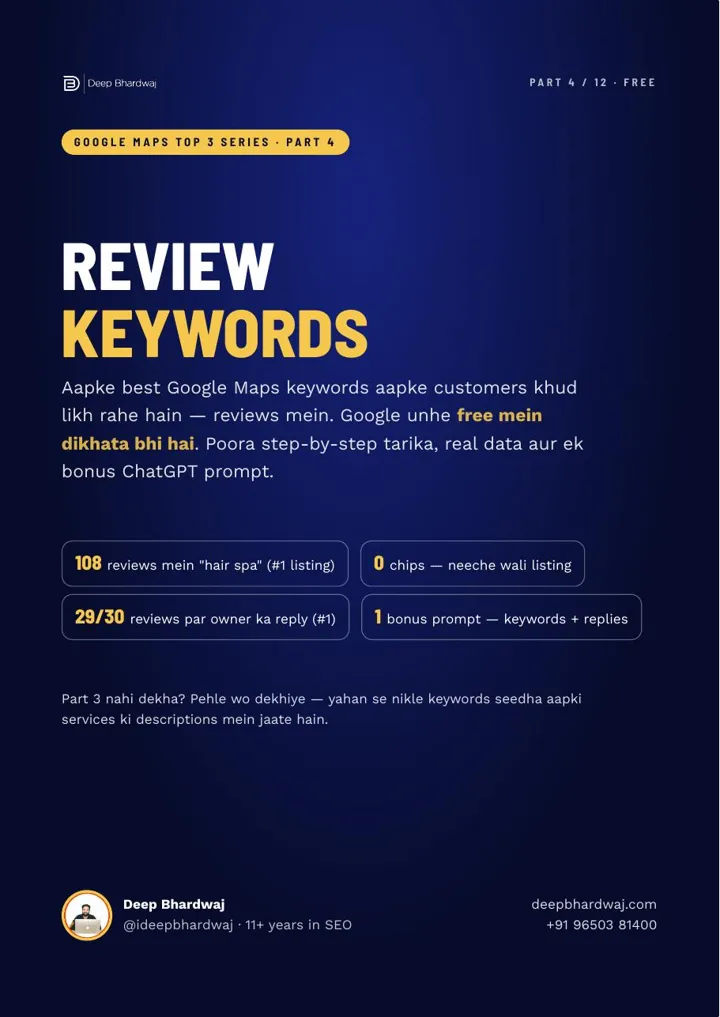
- The #1 “salon in karol bagh” listing had 1,791 reviews, with “hair spa” in 108 of them and “hair colour” in 74.
- A lower listing in the same search, with 40 reviews, showed no review chips at all.
- Use a chip word only for a service you really offer: in service descriptions, posts, replies and your business description.
- Reply to every review within 24 to 48 hours and name the service the customer took.
- Ask every customer to mention the service in their own words, and never write the review or offer a reward for it.
Contents
What are review keywords, and where does Google show them?
Review keywords are the service words your customers use when they describe you in a review, such as “hair spa”, “keratin treatment” or “bridal makeup”. They matter because they are usually the same words people type into Google when they look for a business like yours, and your customers write them for you, free.
Google even points them out. When enough reviews use the same word, it shows a small button, or chip, above the Reviews tab, with a count. Tap a chip to see only those reviews.
This is Part 4 of our “Google Maps Top 3” series, and these words feed straight into the service descriptions you wrote in Part 3. Reviews in a Hindi-English mix count too. They show how people really talk, which helps if you are weighing whether your website needs Hindi or Hinglish pages.
What does real Google Maps data show?
On 22 October 2026 we searched “salon in karol bagh” on Google Maps. The #1 listing had 1,791 reviews, and its chips read like a keyword list: “polite staff” in 150 reviews, “hair spa” in 108 and “hair colour” in 74. A listing lower down, with 40 reviews, had no chips at all.
Does that mean review keywords alone put the salon on top? No. Google’s tips on local ranking say results depend mainly on relevance, distance and prominence, with review count and rating feeding prominence. Expert surveys such as the Whitespark and Moz ranking factor studies list keywords in reviews as one factor among many.
For the wider picture, read which Google Business Profile ranking factors actually move the needle in 2026. Review keywords give you something simpler: the words your market really uses.
How do I find the review keywords of the Top 3?
Start with the businesses that already rank. Search your main service plus your area on Google Maps, open each of the top three listings, read the chips on their Reviews tab and write them down next to your own. The words all three share, and you don’t, are your gaps.
- Search your keyword plus your area on Google Maps, for example “salon in karol bagh”.
- Open the #1 listing and go to the Reviews tab. The chips sit at the top, each with its count.
- Tap a chip to read only those reviews, and note the exact phrases customers use.
- Repeat for #2 and #3, then check your own listing. Put everything in one note.
No chips on your listing yet? Google shows them only once enough reviews use similar words. The next steps fix that.
Where should I use these keywords on my profile?
Use a review keyword only for a service you genuinely offer, and only where it reads naturally. The four places that matter are your service descriptions, your weekly Google posts, your review replies and your business description. One natural mention in each place does more than ten forced ones.
- Service descriptions: two or three lines in the customer’s own words, so “Hair spa” actually says “hair spa”.
- Google posts: one post a week around one keyword. Part 5 turns these words into a 4-week Google post plan.
- Review replies: name the service, as shown below.
- Business description: your top two or three services, once.
Don’t paste every chip into every field. Keyword stuffing makes a listing look spammy, and Google’s guidelines for representing your business on Google do not allow service keywords in your business name at all.
Clinics and diagnostic centres feel this most, because patients read reviews closely before booking. Review language is a regular part of our SEO work for hospitals and clinics.
How do I reply to reviews using these keywords?
Reply to every review within 24 to 48 hours. Thank the customer by name, mention the service they took, and add your area or branch only where it fits naturally. Write each reply fresh. That way replies reinforce your keywords without sounding robotic, and future customers see someone is listening.
The #1 salon replied to 29 of its last 30 reviews. Google’s help page on managing and replying to customer reviews shows how to reply from your profile. Here is how good and bad replies differ:
| Check | Good reply | Bad reply |
|---|---|---|
| Opening | Thanks the customer by name | “Thanks for review.” |
| Service | Names the one service they took | Lists every keyword at once |
| Area | Mentions the branch once, naturally | “Best salon karol bagh” |
| Originality | Written fresh each time | Same line under every review |
A sample from the guide: “Thank you Priya ji! So glad you liked the hair spa at our Karol Bagh studio.” Reply to negative reviews too, calmly and without arguing.
How can I get more reviews that mention my services?
You can’t control what customers write, but you can make it easy for them. When you ask for a review, request that they mention which service they had and how it went. Over time more of your reviews contain those words, and chips start to appear on your listing.
Stay inside the rules. Google’s Maps policy on fake and incentivised reviews means the review must be in the customer’s own words, with no discount or gift in return, and you shouldn’t ask only happy customers. Ask everyone.
The free guide has a polite WhatsApp message that asks for exactly this. Detailed reviews also help if you want AI assistants to recommend your brand by name. Expect chips to take months, not days, much like the time SEO takes to show results.
How do I turn this into a weekly routine?
Keep it small and regular. Every week, reply to new reviews within 24 to 48 hours and name the service. Every month, check your chips and the Top 3’s chips again and note any new words. Then build one Google post a week around one of those keywords.
The guide’s bonus ChatGPT prompt turns your notes into a keyword table, five fresh replies and a review-request message. In its worked example, a salon finds “hair spa” on all three top listings but not its own, so the word goes into its service description, replies and a post.
“Aapke best keywords aapke customers khud likh rahe hain, bas padhna seekhiye.” Your customers are already writing your best keywords. You only have to learn to read them.
— Deep Bhardwaj
Steady habits like this sit behind most of the ranking results our clients have seen.
Is this worth the effort for a local business?
Yes. Google review keywords cost nothing, your customers write them for you, and they show exactly how your market describes your services. Read the chips, use the words honestly, reply to every review and ask everyone for feedback. Results differ by business and area, but every new review adds to your list.
Want a team to handle reviews, posts and categories together? See our local SEO services for Indian businesses, or send us your listing and get a free SEO audit of what is missing.
Services that help with this
- Local SEO services: Google Business Profile work, including reviews, replies, categories and posts, done for you.
- SEO company in India: Full SEO for your website and listing, so the words customers use show up across both.
- Free SEO audit: A free check that shows which service keywords are missing from your profile and reviews.
TL;DR
- Review chips on Google Maps show the service words customers repeat most, with a count.
- Read the Top 3’s chips, find the words you lack, and use only those for services you offer.
- Reply to every review within 24 to 48 hours and name the service, with no copy-paste lines.
- Ask every customer to mention the service in their own words, with no rewards and no review gating.
Frequently asked questions
Can I choose or edit the review chips on my listing?
No. There is no setting in your Business Profile to pick, edit or hide review chips. Google builds them automatically from the words that appear in many of your reviews. The only way to influence them is the honest way: serve customers well, ask everyone for a review and request that they mention the service they had. New chips tend to appear as those words build up.
Should I reply to old reviews I missed?
Yes. A late reply is better than none, because future customers read replies when they compare businesses. Start with the most recent reviews and any negative ones, then work backwards a few at a time. Keep each reply personal and name the service where you can. Avoid replying to dozens in one sitting with the same line, which looks automated.
What if a review mentions a service I don’t offer?
Don’t add that service to your profile just because it appears in a review. Thank the customer, and if the review could confuse others, gently clarify what you do offer. If many customers ask for a service you don’t provide, that is useful business feedback, but only list it once you genuinely offer it. Your keyword list should always match real services.
Can customers write reviews in Hindi or Hinglish?
Yes. Customers can write in whatever language feels natural to them, and you should never ask them to switch. Keywords in Google reviews still count as useful signals of how people describe you, whatever the language. When you reply, use the same language the customer used, keep it short and personal, and mention the service naturally if it fits.
Should I use my review keywords on my website too?
Yes, where they genuinely fit. If customers keep saying “hair spa” rather than “scalp treatment”, use their phrase on your service page headings and text. It keeps your website and Google listing consistent and matches how people search. Write for readers first, avoid repeating the word in every sentence, and make sure each page really describes that service.