Category: Blog

Your blog category

  • Zero-Click Search Hit 70% — Here’s the Playbook That Still Drives Traffic

    Zero-Click Search Hit 70% — Here’s the Playbook That Still Drives Traffic

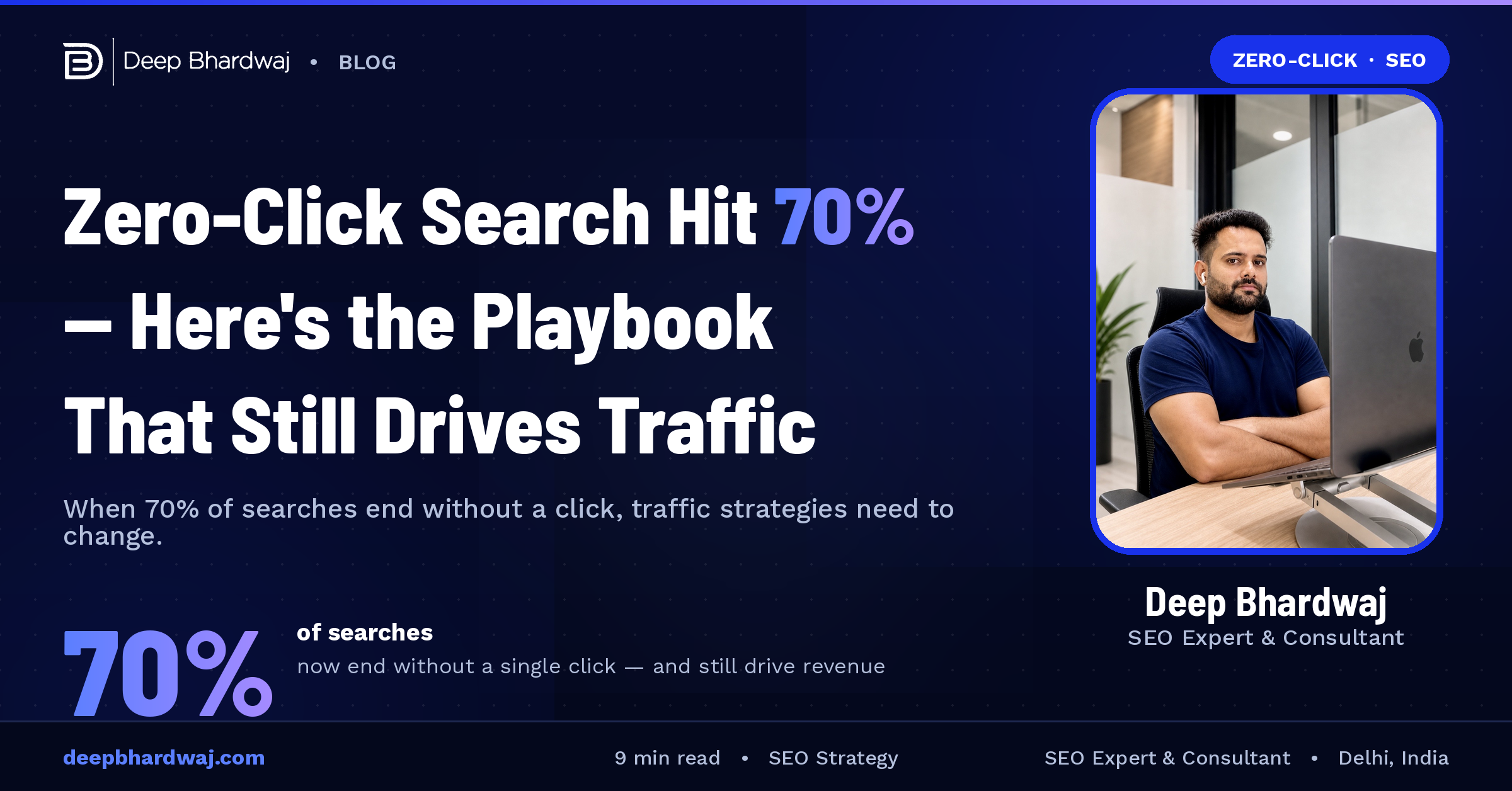
    By the end of 2025, roughly seven out of ten Google searches ended without a single click. AI Overviews, featured snippets, and instant answers absorbed the rest. If your traffic strategy still depends on the user clicking through, you are competing for the 30% of queries that survive — and that share is shrinking. A modern zero click search strategy accepts that reality and builds around it instead of fighting it. As an SEO expert in India helping brands retool their funnel for the zero-click era, the playbook below is the one I now run with every client whose informational traffic has flattened.

    This guide breaks down what zero-click really means, why your traffic dropped, and the seven-part playbook that lets brands turn impression-only visibility into actual qualified demand. Most of these tactics also strengthen your SEO and GEO performance simultaneously.

    What 'Zero-Click' Actually Means

    A zero-click search is any query where the user finds their answer on the search results page — featured snippet, AI Overview, knowledge panel, People Also Ask — and never visits a website. SparkToro's zero-click study pegs the rate at 65–70% globally and rising. For informational queries, it's already over 80%.

    This is not a temporary glitch. Google's product direction is to answer queries on-platform. Brands that adapt earn brand impressions; brands that don't lose visibility entirely.

    Why Your Traffic Dropped Even Though Rankings Held

    Most clients I talk to in 2026 are seeing the same shape of decline: rankings stable or improved, organic traffic down 20–40%. The reason is simple — rank doesn't equal click anymore. Position #1 used to mean ~32% click-through rate. In AI-Overview-dominant queries, it now hovers around 8–12%. The lost CTR is the lost traffic.

    If your weekly reporting still leads with rank and traffic, you're tracking the wrong scoreboard.

    A useful sanity check: pull a 90-day Search Console comparison of impressions vs clicks for your top informational queries. If impressions are up or flat while clicks are sharply down, you have a zero-click problem, not a ranking problem. Trying to fix it with link building or technical SEO won't help — the issue is downstream of ranking and needs a strategy-level response.

    The 7-Part Zero-Click Playbook

    This is the playbook I run for every Bhardwaj Consultants client adapting to the new reality.

    • Optimise for citations, not clicks — be the source of the AI answer.
    • Treat impression share as the primary KPI for top-of-funnel content.
    • Brand the answer — every direct answer should mention your brand name naturally.
    • Concentrate on bottom-funnel queries — "best," "vs," "pricing," "alternatives," where users still click to buy.
    • Build branded query demand — the only fully click-through traffic class.
    • Diversify into Reddit, YouTube and LinkedIn — platforms with real, clickable presence.
    • Measure conversion-rate uplift on the traffic that does arrive — it's higher quality post-AI.

    The Branded Query Multiplier

    Branded queries are the single click-through stronghold left. When someone Googles your brand name, they click — almost always. So the long-term zero-click strategy is to make people search for you by name. HubSpot's research on branded search shows brands with strong branded query growth retain organic traffic at 2–3x the rate of unbranded-only competitors, even as AI Overviews expand.

    That means investing in PR, founder visibility, content distribution, podcasts and community — anything that creates name recall. SEO budgets in 2026 are starting to look more like brand-marketing budgets, and that's correct.

    Bottom-Funnel Queries Still Convert

    While informational top-of-funnel queries are losing clicks, bottom-funnel queries — pricing, alternatives, comparisons — still drive click-throughs above 40%. Reallocate content effort here. For e-commerce specifically, our ecommerce SEO services package now allocates 60% of content effort to bottom-funnel comparison content versus 30% pre-2024.

    Specifically for India-focused brands, queries that include city names ("best CRM Bangalore", "SEO consultancy Mumbai") convert at 3–4x the rate of generic versions of the same query and trigger AI Overviews far less often. Rebalancing toward locally-modified bottom-funnel queries is one of the highest-leverage moves available right now.

    Reporting in a Zero-Click World

    Update your dashboards. Track impression share, AI citation share, branded query growth, conversion-rate per session, and assisted-conversion attribution from organic. Drop average position and total sessions from the headline metrics — they describe a world that is gone. Brands that update their reporting first also typically update their strategy first, and that compounds.

    When presenting these metrics to leadership, anchor every number to a business outcome. "Branded search volume up 28% quarter-on-quarter" should be paired with "direct traffic up 22% and conversion rate up 18%." A quarterly board update built on this story holds up; the legacy traffic-and-rank story increasingly does not.

    What to Do This Week — Your Zero-Click Adaptation Quick-Start

    Pull a 90-day Search Console comparison of impressions versus clicks for your top 30 queries. Sort by widening impression-to-click gap. Those queries are where AI Overviews and featured snippets are absorbing your traffic. They are also where you need to either accept the impression-only outcome or move the page to bottom-funnel content with stronger conversion intent.

    Within seven days, update your reporting dashboards to track impression share, branded query growth, and conversion-rate per session — not total sessions. Brief leadership on the new metrics so quarterly reviews don't keep referencing dashboards that no longer reflect organic reality. The reporting reset is half the strategy reset, and it earns far less attention than it deserves.

    The Bottom Line

    Zero-click search is not a problem to solve — it is the new shape of organic discovery. The brands winning are the ones who accepted that early and rebuilt their strategy around citations, branded demand, and bottom-funnel conversion. If your traffic is down but your brand awareness is rising, you are doing it right. If both are falling, this playbook is your fastest route back. Start with the seven-step framework, change the metrics, and within six months you'll see qualified traffic and demand recover.

    Frequently Asked Questions

    What percentage of Google searches are zero-click in 2026?

    Independent studies put the figure at 65–70% of all Google searches and rising. For informational queries specifically, it's already above 80%. Commercial and navigational queries still produce clicks at higher rates, but the overall trend is unambiguous — most queries now end on the search results page.

    Is zero-click SEO the same as GEO?

    Closely related but distinct. GEO (generative engine optimization) focuses on getting cited inside AI answers across ChatGPT, Perplexity, Gemini and Google AI Overviews. Zero-click SEO is broader — it includes optimising for featured snippets, knowledge panels, People Also Ask boxes and AI answers. Most strong GEO tactics also reduce your zero-click exposure.

    Should I stop creating informational content?

    No, but reduce the share. Informational content still earns impressions, brand mentions and AI citations — all of which build long-term brand recall. The mistake is allocating 70% of content effort to informational queries while expecting the click-through rates of 2019. Shift toward 50/50 informational versus bottom-funnel commercial content.

    Which industries are hit hardest by zero-click?

    Health, finance, definitions, how-to and basic technology queries are seeing the steepest click-through decline because Google can answer them confidently in an AI Overview. Niches with subjective opinions, comparisons, or strong personal experience requirements (travel, B2B SaaS reviews, complex legal questions) retain healthier click-through rates.

    How do I prove the value of zero-click impressions to my CFO?

    Stop reporting traffic alone — report assisted conversions and branded query growth. Pull a 90-day before/after snapshot showing branded search volume, direct traffic, and conversion rate per session. Most clients show 30–60% conversion rate uplift on the post-AI traffic that does arrive, because users now reach the site already pre-qualified by the AI answer. That's the case you take to finance.

  • Programmatic SEO With AI: Build 10,000 Pages Without a Penalty

    Programmatic SEO With AI: Build 10,000 Pages Without a Penalty

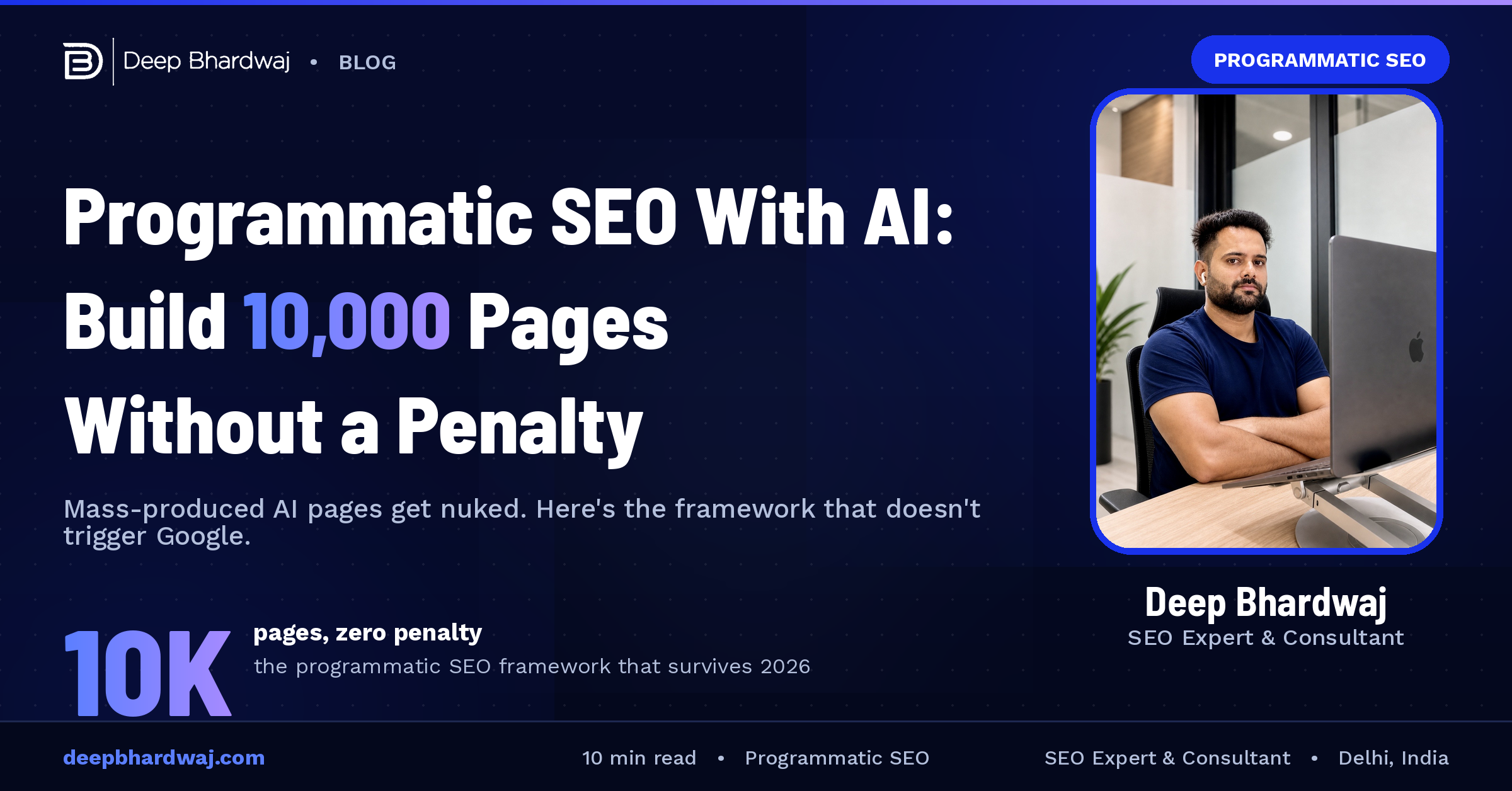
    Programmatic SEO has always promised scale. AI made it possible to ship 10,000 pages in a sprint — and Google's March 2024 spam policy update made it possible to wipe them out in a single algorithm refresh. Programmatic SEO with AI is now a discipline of building scaled content that adds genuine value, not duplicating templates with thin content. As an SEO expert in India working with aggregators, comparison sites and SaaS hubs on scaled content, the difference between a campaign that compounds and one that gets wiped is now measurable.

    This guide is the framework I use with clients launching scaled content campaigns — from real-estate aggregators to SaaS comparison hubs — without triggering scaled-content-abuse penalties. Done right, programmatic SEO is one of the highest-leverage SEO plays of 2026. Done wrong, it kills the parent domain.

    What Google's 2024 Spam Policy Actually Banned

    Google did not ban AI content. They banned scaled content abuse — content produced at scale where the primary purpose is to manipulate rankings, with little user value. Google's official spam policy update is explicit: scale is fine if value is high.

    The brands hit hardest in the rollout were the ones publishing identical templated pages with only city or product names changed. The brands untouched were producing programmatic pages with genuinely unique data per page.

    The 5 Conditions for Safe Programmatic SEO in 2026

    Every page must meet all five — failing any one risks the entire campaign:

    • Each page solves a real, searched user need (verified with keyword research).
    • Each page contains genuinely unique data the user can't easily get elsewhere.
    • Templates are minimal — at least 60% of each page should be unique content.
    • Internal linking is tight; orphan programmatic pages are a major risk.
    • Quality control: random samples reviewed by a human for usefulness before publish.

    The Right Use Cases (And the Wrong Ones)

    Programmatic SEO works brilliantly when each page genuinely answers a unique query: "Mumbai to Pune drive time" with real-time traffic data, "Bangalore to Goa flights" with live pricing, "Sony WH-1000XM5 vs Bose QC Ultra" with detailed comparison. It fails when pages are templated with no per-page substance.

    Rule of thumb: if a human couldn't tell two of your pages apart in five seconds, neither can Google. Don't ship that.

    Another useful filter: would a real human user bookmark this page? If the answer is no, the page is unlikely to earn engagement signals (return visits, time-on-page) that Google uses to validate quality. The best programmatic SEO pages have specific, actionable, useful information that someone would genuinely want to revisit. Templates without that core utility are the ones that get penalised.

    The AI-Assisted Programmatic Workflow

    I use a 4-stage workflow that ships safely at scale:

    • Stage 1: Build a structured database with unique data per row.
    • Stage 2: Design a hybrid template — fixed structure, AI-generated unique sections.
    • Stage 3: AI generates the unique sections grounded in the database row (RAG-style).
    • Stage 4: Human review on a 5–10% sample, automated quality checks on the rest.

    Internal Linking and Indexation Discipline

    Programmatic pages with no internal links to them get ignored by Google. Build a navigable hub structure: each programmatic page must be reachable in 3 clicks from the homepage. Use breadcrumbs, related-page widgets, and category indexes. Search Engine Land's coverage of programmatic SEO architecture provides solid examples.

    If you're running an e-commerce or marketplace site, pair this with our ecommerce SEO services to ensure programmatic landing pages convert as well as they rank.

    How to Test Before Launching at Full Scale

    Never launch 10,000 pages day one. Ship 100 pages first, monitor Google Search Console for indexation rate and impression share over 30 days, then scale 10x in stages. Sites that follow this gate-by-gate scaling rarely get penalised. Sites that ship everything at once and hope for the best frequently do.

    A practical staging schedule: 100 pages on Day 1, monitor for 30 days, scale to 1,000 if indexation health is good, monitor 30 days, scale to 10,000. Each gate has explicit pass/fail criteria — indexation rate above 80%, no manual actions, impression growth tracking page count. Most penalties come from skipping gates and dumping the full library at once. Disciplined gating prevents 90% of the risk.

    What to Do This Week — Your Programmatic SEO Quick-Start

    Identify the unique data source that will power your programmatic campaign. If you don't have one, programmatic SEO is not the right tactic — go solve the data problem first. If you do, define the schema for one row of unique data and decide what each generated page will contain.

    Within seven days, build the template for ten test pages and ship them. Monitor indexation in Google Search Console for 14 days. If indexation rate is above 80% and there are no manual actions, scale to 100 pages. Disciplined gating like this is what separates programmatic SEO that scales from programmatic SEO that gets penalised. Skip the gates and you skip the safety net.

    The Bottom Line

    Programmatic SEO with AI is one of the highest-leverage growth plays available in 2026 — but only with discipline. Build pages that solve a real query, ground every page in unique data, keep the human review loop in place, and scale in stages. Skip any of those and the algorithm will eventually catch up. Get them right and you'll dominate long-tail traffic for years before competitors can replicate the structure.

    Frequently Asked Questions

    Is AI-generated content allowed by Google?

    Yes, with one major caveat: Google's policy is content-quality-first, not AI-aware. AI-generated content that adds genuine user value, is grounded in unique data, and has human review is fully acceptable. AI content produced at scale to manipulate rankings — without unique data or value — falls under the scaled content abuse policy and is demoted aggressively.

    How many pages can I safely launch at once?

    There's no hard cap, but staged rollouts perform better. Start with 100 pages, observe indexation and impression growth over 30 days, then scale 10x — 1,000 pages — and observe again. This catches quality issues before they affect the whole campaign and signals to Google that the site is growing organically rather than dumping a content farm.

    What unique data sources work for programmatic SEO?

    Anything proprietary or aggregated. Real-time pricing, live availability, calculated comparisons, structured product specs, location-specific datasets, government data (RBI, IRDAI, FSSAI), public APIs, scraped-and-restructured open data. The best programmatic SEO sites have a defensible data moat — competitors can't replicate the pages because they don't have the data.

    Do I need to add structured data to programmatic pages?

    Yes — appropriate schema is one of the highest-leverage additions. Product, Offer, FAQ, Breadcrumb, and where relevant LocalBusiness schema all help Google parse the unique data on each page. Structured data also dramatically improves the chance of being cited in AI Overviews and Perplexity answers, where data-rich pages have a clear advantage.

    How do I monitor programmatic SEO health?

    Track three things weekly. Indexation rate (how many of the launched pages are indexed in Google), impression share (rising should accompany indexation), and quality score per page sample (5% audit). Sudden drops in any of these mean you've crossed the quality line — pause publishing and audit before continuing. Catching issues at 1,000 pages is recoverable; catching them at 50,000 often isn't.

  • AI Content Detection: Will Google Penalize ChatGPT-Written Posts?

    AI Content Detection: Will Google Penalize ChatGPT-Written Posts?

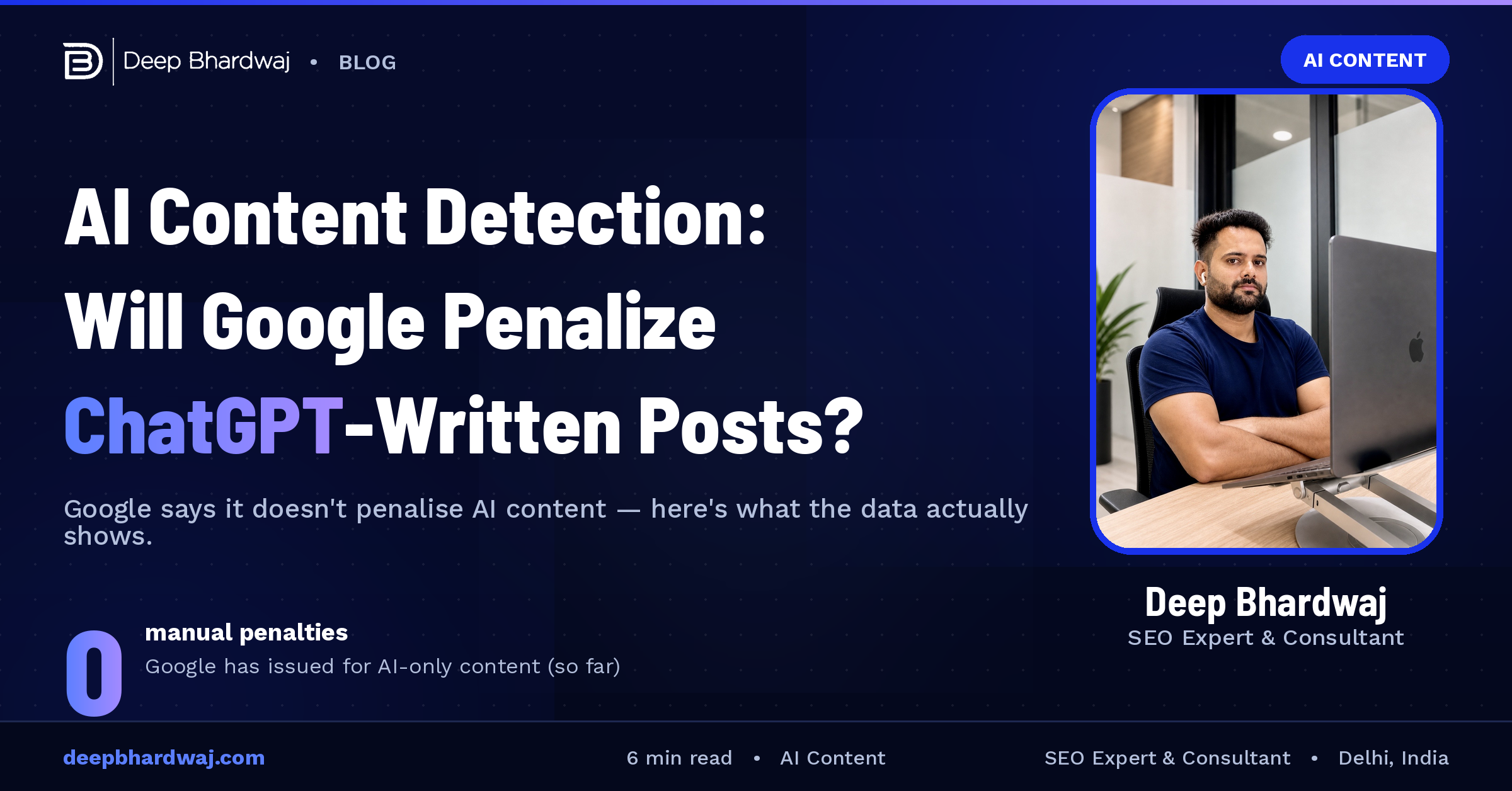
    Three years into the AI content era, the question every editor, SEO and brand asks me weekly: "will Google penalise my ChatGPT-written posts?" The honest answer is more nuanced than either AI evangelists or AI doomsayers will admit. Google does not detect or penalise AI content per se. They detect and penalise low-quality scaled content — which AI happens to make easy to produce. Understanding the difference is the difference between using AI productively and triggering an AI content Google penalty that wipes the site. As an SEO expert in India advising publishers and brands on AI-assisted content workflows, the line between safe AI use and a quality penalty is now sharper than it looks.

    This guide covers Google's actual policy, what triggers demotion, what doesn't, and the practical guidelines I use with every Bhardwaj Consultants client publishing AI-assisted content.

    What Google's Policy Actually Says

    Google's official position, restated multiple times by John Mueller and Search Liaison: AI-generated content is acceptable when it is helpful, original, demonstrates expertise, and is reviewed by humans. AI content produced primarily to manipulate rankings — the policy term is "scaled content abuse" — is penalised regardless of human or AI authorship.

    Google's official guidance on AI content is direct: "focus on quality of content, rather than how content is produced."

    What Actually Triggers Demotion

    From auditing 30+ sites that lost rankings in the 2024–2026 spam updates, the patterns are consistent:

    • High-volume publishing of templated AI content with minimal differentiation
    • Articles with no human review trail or named author
    • Content lacking original research, examples, or first-hand experience
    • AI content on YMYL topics (medical, financial, legal) without expert review
    • Pages that read as if written for SEO bots, not humans

    What Doesn't Trigger Demotion

    AI assistance done correctly is not a problem:

    A simple way to think about the line: would a knowledgeable reader look at this page and say "a real expert wrote this"? If yes, you're safe regardless of how much AI was involved. If no — even if a human technically typed every word — you have a quality problem. The algorithm is approximating that human judgment, not detecting AI tooling.

    • Human-written drafts polished or expanded with AI assistance
    • AI-generated outlines refined and rewritten by experienced humans
    • AI content reviewed, fact-checked, and supplemented with first-hand insight
    • AI translations reviewed by a native speaker before publishing
    • AI summarising original research where humans produced the underlying research

    Does Google Have an AI Detector?

    Officially, no. Practically, Google has access to billions of training samples and clearly identifies stylistic patterns of common AI tools. The bigger signal is statistical anomaly — sites suddenly publishing 10x their historical volume, sites with thin author entities, sites with templated structure across many pages. Those patterns get flagged and reviewed regardless of whether the content was "AI-detected."

    Search Engine Roundtable's coverage of Google AI detection comments catalogues the official statements over the last 24 months.

    The Safe AI-Assisted Workflow

    I run the same workflow with every client publishing AI-assisted content:

    Document the workflow internally. When Google sends a manual action notification (rare but possible), they often request evidence of editorial process. Brands that can show a documented review trail — brief, draft, expert review notes, fact-check log, named reviewer — have a much easier path to reconsideration than brands that can only point to the published article and say "trust us, we reviewed it."

    • Topic and angle decided by a human strategist with the E-E-A-T shift after the March 2026 core update credentials.
    • AI generates a structured first draft from a detailed brief.
    • Human expert rewrites for voice, adds first-hand experience, removes filler.
    • Editor adds proprietary statistics, real screenshots, named expert quotes.
    • Fact-check pass against primary sources.
    • Publish with named author, sameAs schema, and disclosed AI assistance where appropriate.

    Special Considerations for YMYL and Local Content

    YMYL topics demand more scrutiny. Medical, legal, financial content without an expert reviewer named on the page is high risk. For local content tied to real businesses — like our local SEO services clients — AI-written GBP posts are a measurable demotion signal. Use AI for research and outlining; let the actual business owner finalise the voice. The same caution applies to content for our ecommerce SEO services clients on regulated product categories.

    What to Do This Week — Your AI Content Quick-Start

    Audit the last 30 days of published content. For each piece, document: who briefed it, who drafted it, what AI tools were involved, who reviewed it, what facts were verified. Pieces failing this audit need their workflow redesigned, not necessarily their content rewritten.

    Within seven days, design and document your AI-assisted editorial workflow: brief format, prompt structure, human review checklist, fact-check log, named publishing reviewer. Apply it to the next ten pieces. Brands that operationalise this workflow ship faster and safer than brands using AI ad-hoc — and they have an answer ready if Google ever asks how their content is produced.

    The Bottom Line

    There is no Google AI content penalty in the abstract. There is a quality, originality and human-review penalty that AI-heavy publishing pipelines trigger when they cut corners. Use AI as a productivity multiplier inside a disciplined editorial workflow — human strategy, AI drafting, expert review, fact-checking, named authors, disclosed assistance — and you will publish faster than ever without exposure. Skip the discipline and the algorithm will eventually catch up. The brands winning in 2026 are the ones using AI exactly this way.

    Frequently Asked Questions

    Can Google detect ChatGPT-written content?

    Google has not confirmed a specific AI detector and probably does not need one. They detect quality and originality patterns — thin templated content, statistical anomalies in publishing volume, lack of human-review signals, missing E-E-A-T markers. AI content that hits all those negatives gets flagged regardless of the underlying tool. The trigger is content quality, not AI authorship.

    Should I disclose when I use AI in my content?

    Disclosure is best practice but not legally required for SEO purposes. Disclosure becomes important on YMYL topics where readers need to assess credibility, and in jurisdictions with emerging AI transparency rules (EU, parts of the US). For SEO specifically, what matters more is having a named, credentialed author who reviewed and is accountable for the content — disclosed AI use is a trust signal, not a penalty signal.

    Is there a percentage of AI content that's safe?

    Google's policy is content-quality-first, not percentage-based. A 90% AI-generated article that is fact-checked, expanded with original insights, and approved by a credentialed human reviewer is safer than a 30% AI-generated article published with no review. Focus on the editorial workflow, not on hitting a magic AI-percentage threshold.

    How do I recover if my site was hit by a content quality update?

    Audit your last 12 months of content. Identify articles that fail E-E-A-T (no named author, no first-hand experience, templated structure, no original data). Either rewrite them with credentialed authors, consolidate them into stronger pillar pieces, or remove them. Recovery typically takes 60–90 days and accelerates significantly if a refresh of the same algorithm rolls during the recovery window.

    Can I use AI to translate content for international SEO?

    Yes, with native-speaker review. AI translation has improved enormously and is suitable for first drafts in major languages. But Google penalises low-quality machine translation, so always have a native speaker review for tone, idiomatic expression, and cultural accuracy. The combined AI-draft + native-review workflow produces better results than either alone, at a fraction of pure-human translation cost.

  • Google Business Profile Ranking Factors That Actually Move the Needle in 2026

    Google Business Profile Ranking Factors That Actually Move the Needle in 2026

    Most Google Business Profile advice on the internet is from 2020. The factors that mattered then either stopped mattering, got down-weighted, or were replaced by new signals tied to AI Overviews and conversational local search. Knowing the real GBP ranking factors 2026 is the difference between investing time correctly and investing it in tactics that produce nothing. As an SEO expert in India advising local businesses across Bangalore, Mumbai and Delhi, the GBP ranking factors that move the needle in 2026 look very different from what worked in 2020.

    This is the field-validated 12-factor playbook from 50+ Indian local businesses I've worked with in 2025–2026. Order matters — the top factors carry the most weight. Skip none of them.

    The Factors That Lost Weight

    Three things mattered less in 2026 than five years ago: pure citation volume (now quality + consistency matter more), GBP description keyword stuffing (gets you penalised, not promoted), and bulk Q&A self-answering (Google now detects and discounts).

    If you're still spending budget on these, redirect it.

    The 12 GBP Ranking Factors That Actually Move the Needle

    Ranked by leverage:

    • Primary category accuracy and specificity
    • Proximity to the searcher
    • Review count, velocity, and recency
    • Review keyword diversity
    • GBP profile completeness across every section
    • Photo upload frequency and originality
    • GBP post cadence (weekly minimum)
    • Service area accuracy and Service detail completeness
    • Citation consistency (NAP exactly matched on 50+ directories)
    • Local backlinks from in-region authoritative sites
    • Owner-uploaded videos (a 2025–2026 emergent factor)
    • Q&A activity with genuine customer questions answered promptly

    Primary Category — The Single Highest-Leverage Setting

    Get this wrong and you'll never rank. Google\’s GBP category documentation lists every available category — pick the most specific that matches. Pick the most specific category that matches your core service. "Restaurant" is too broad if you're a "South Indian Restaurant." Google's GBP help on category selection explains the categories — but the right pick comes from looking at what categories your top-ranking competitors use.

    Reviews — The Velocity Compounding Effect

    Five reviews this month outweigh fifty reviews from two years ago. Semrush\’s local ranking factor analysis confirms review velocity now outweighs total review count. Build a daily review-request workflow: every paying customer gets asked at the moment of peak satisfaction. Aim for 5–10 new reviews monthly minimum. Respond to every review within 48 hours — yes, including the negative ones.

    Reviews mentioning service or product names by name ("the haircut at this Mumbai salon was perfect") carry extra ranking weight beyond the star count alone. Train your team to encourage descriptive reviews, never script them.

    There is an asymmetric pattern worth knowing about: a single recent 1-star review hurts more than a single recent 5-star review helps. Responding to negative reviews thoughtfully and publicly within 48 hours reduces the ranking damage substantially. Ignored negative reviews compound; addressed negative reviews fade. Make the response part of your operations rather than your marketing.

    Photos and Videos — The Underused Weapon

    GBP profiles with weekly original photo uploads outrank profiles with one-time photo dumps by a significant margin. Owner-uploaded videos — even short, low-production smartphone clips — are an emerging high-leverage signal in 2025–2026. The brands not yet using video on GBP are the ones easiest to outrank right now.

    Geo-tagged photos uploaded from on-site (rather than uploaded from a desktop) appear to carry slight extra weight, though Google has never confirmed this. The practical implication: have staff upload photos from their phones while on-premises rather than uploading them later from the office. The cost is zero; any uplift is pure upside.

    GBP Posts and Q&A — The Activity Signals

    Weekly GBP posts. At minimum. Use the Update, Offer, and Event types — varied content beats repetitive content. Answer every Q&A submitted within 24 hours; pre-seed 10–15 of your most-asked questions yourself with thorough answers (this is allowed and useful, but only if the questions are real).

    Local SEO services clients we run report 30–50% Map Pack ranking improvement within 60 days of starting a disciplined post + Q&A cadence — without changing anything else.

    Citations and Local Links

    50+ citations on directories with exact NAP match. Local backlinks from regional newspapers, business associations, and "best of city" round-ups. Generic guest-post links don't move local rankings. Local links do — disproportionately. Plan a quarterly outreach campaign focused on 3–5 high-quality local links per quarter.

    What to Do This Week — Your GBP Quick-Start

    Confirm your primary GBP category is the most specific accurate match for your core service. Compare against the top three Map Pack competitors in your city — if they're using a more specific category and you aren't, that single change can move you up several positions over 30 days.

    Within seven days, schedule weekly GBP posts (mix Update, Offer, Event types), commit to monthly photo uploads from inside the business, and set up a daily review-monitoring alert so you respond within 48 hours to every new review. These three operational disciplines, sustained for 90 days, are the most reliable lever for moving Map Pack positions in 2026.

    The Bottom Line

    Google Business Profile optimisation in 2026 is not a one-time setup task — it is an ongoing operational discipline. The 12 factors above ranked in order are the playbook. Sites that maintain weekly cadence on the activity factors (posts, photos, Q&A, reviews) and quarterly cadence on the structural factors (categories, citations, links) consistently win Map Pack positions. The brands losing are the ones still treating GBP as something they set up once and forgot. If you want a partner to run that cadence, that's exactly what my local SEO services programme delivers.

    Frequently Asked Questions

    How important is GBP category selection vs other factors?

    Primary category is the highest-leverage single setting on your GBP. The wrong category caps your maximum reachable ranking, regardless of how well you optimise everything else. Spending an hour analysing top-ranking competitors' categories and selecting the most specific accurate match is the highest-ROI hour you can spend on local SEO.

    How often should I post on GBP?

    Weekly minimum, ideally twice weekly. The activity signal is what Google measures — not whether the posts go viral. Mix Update, Offer, and Event post types. Each post should include an image and a clear call-to-action. Skipping weeks signals neglect; posting twice weekly signals an active, current business — which is exactly what AI Overviews and Map Pack rankings reward.

    Do GBP photos really affect rankings?

    Yes — significantly. Profiles with weekly original photo uploads rank higher than profiles with stale photo galleries, even when other factors are equal. Originality matters: stock photos hurt more than they help. Smartphone snaps from inside the business — kitchen shots for restaurants, treatment rooms for clinics — outperform polished marketing shots in our testing.

    Are paid GBP services worth the money?

    Reputable agencies running disciplined cadence earn their fee. Be cautious about cheap services promising bulk reviews or citation submissions — they tend to use grey-hat tactics that work briefly then collapse. The right test: ask the agency what their weekly cadence looks like for posts, photos, and review responses. If they can't answer concretely, they're selling automation, not strategy.

    How long does it take to see GBP ranking improvements?

    First measurable improvements typically appear at 30 days of disciplined optimisation; meaningful Map Pack movement at 60–90 days; full top-3 dominance at 6–12 months. The variable is competition density — a Bangalore dental clinic competes harder than a Bangalore plumber, so timelines stretch. Consistent execution beats intensity every time.

  • INP Replaced FID — How to Fix Interaction to Next Paint Issues Fast

    INP Replaced FID — How to Fix Interaction to Next Paint Issues Fast

    When Interaction to Next Paint (INP) replaced First Input Delay as a Core Web Vital in March 2024, half the web instantly went from "passing" to "needs improvement." Two years on, INP is still the metric most sites struggle with. The good news: the fixes are concrete, well-documented, and most can be deployed by an experienced developer in a week. This guide walks through the interaction to next paint fix approach I run on every Bhardwaj Consultants client website that needs Core Web Vital recovery. As an SEO expert in India who has fixed INP issues on dozens of high-traffic sites in 2025–2026, the patterns of what breaks INP — and how to fix each one fast — are now extremely consistent.

    Below: what INP measures, why FID didn't catch the real problem, and the seven-step playbook that takes most sites from failing to passing in 14 days.

    What INP Measures (and Why FID Missed the Point)

    FID measured the delay before the browser could start processing the first user interaction. But "start processing" wasn't the user's experience — what users felt was the time until the page actually responded visually. INP measures that full duration: from interaction to next paint. Google's INP documentation defines a good score as under 200ms, needs improvement at 200–500ms, and poor above 500ms.

    If your old FID scores were green, your INP scores are probably yellow or red. That's normal — and fixable.

    Common Causes of Bad INP

    From 30+ INP audits in 2025–26, these are the recurring culprits:

    On Indian audiences specifically, the INP failure pattern is sharper because mobile devices skew older and connectivity is more variable. A site that scores green INP for a US audience may score amber or red for an Indian audience on the same code. Always check INP for your specific geography in CrUX rather than assuming global numbers apply.

    • Heavy synchronous JavaScript blocking the main thread on click
    • Long event handlers — analytics, A/B test scripts, third-party tag managers
    • DOM updates that trigger large re-flows or full page repaints
    • Hydration-blocking React or Vue components on user interaction
    • Sluggish input fields with debounce-less keystroke handlers
    • Excessive console.log in production code

    The 7-Step INP Repair Playbook

    This sequence consistently lifts sites from red to green INP scores. Apply in order — early steps reveal where the heaviest wins live.

    • Run Chrome DevTools Performance with INP profiling on top 5 user paths.
    • Identify the top 3 long-task event handlers and break them up with requestIdleCallback or setTimeout 0.
    • Defer all non-critical third-party scripts (analytics, chat widgets, A/B testers).
    • Replace synchronous DOM batch updates with requestAnimationFrame.
    • Lazy-load components that hydrate only on user intent.
    • Add debounce to input fields with keystroke handlers (search, filters).
    • Re-test in field data via Chrome User Experience Report after 14 days.

    Tools That Actually Help

    Three tools cover 90% of INP debugging needs. Chrome DevTools Performance panel for synthetic profiling. PageSpeed Insights for field data. Web.dev's web-vitals JS library for monitoring INP in your own analytics. Don't bother with paid tools until you've exhausted these — they don't reveal anything additional that matters.

    The Mobile-Specific Pitfalls

    Mobile INP fails harder than desktop because mobile CPUs are weaker and main-thread JS contention is more brutal. Special attention: mobile menu open/close handlers, image carousels, and sticky CTA buttons. For e-commerce sites in particular, our ecommerce SEO services audits routinely find ₹50K+ monthly revenue gains hiding behind a 320ms cart-add INP problem.

    When to Re-Architect Instead of Patch

    If your stack is heavy SPA (single-page app) with thousands of components hydrating client-side, patching INP is a losing battle. Migrate critical paths to server components or static generation. The work is bigger, but the long-term INP, SEO and conversion benefits compound. Don't keep patching what wants to be re-architected.

    There is an in-between option: hybrid rendering. Move critical paths (homepage, top landing pages, product pages) to server-side rendering or static generation while leaving the rest of the SPA. This captures most of the INP benefit at a fraction of the migration cost. Frameworks like Next.js, Nuxt and Remix make this practical now in ways that weren't possible three years ago.

    What to Do This Week — Your INP Quick-Start

    Open Chrome DevTools and run the Performance panel against your top three landing pages on a throttled 4G connection. Record the INP for each interaction. Identify the longest event handler. That single handler is typically responsible for 40–60% of your INP problem on that page.

    Within seven days you can defer non-critical third-party scripts via the script defer or async attribute, break up the longest event handler with requestIdleCallback or setTimeout 0, and add the web-vitals JS library to monitor INP in your own analytics. These three changes typically take a single sprint to ship and produce visible Core Web Vitals improvement within 28 days as field data updates.

    The Bottom Line

    INP is not optional. It is a Core Web Vital and an underlying signal for both Google rankings and user conversion. The seven-step playbook fixes most sites within two weeks. Audit five priority paths, kill the longest event handlers, defer third-party scripts, and re-measure with field data. If you're stuck on a heavy framework, plan a migration before the next core update treats poor INP as a stronger demotion signal — which is the direction the trend is moving. For the technical mechanics, see Google’s web.dev INP documentation and the official web-vitals JS library. For the bigger AI-search picture, read what Generative Engine Optimization actually is.

    Frequently Asked Questions

    Run the audit with the web-vitals JS library.

    When did INP officially replace FID?

    INP replaced First Input Delay as a stable Core Web Vital on 12 March 2024. From that date onwards, INP became the responsiveness metric Google uses in its page experience signals. Sites that hadn't optimised for INP saw measurable Core Web Vitals score drops, with downstream ranking and click-through impact in many verticals.

    What's a 'good' INP score?

    Under 200 milliseconds is considered good. Between 200ms and 500ms is 'needs improvement.' Above 500ms is poor. Google measures INP at the 75th percentile of real-user interactions, which means optimising for typical users isn't enough — you need consistent performance for slower devices and connections too. This makes INP harder to pass than FID was.

    Does INP affect mobile and desktop differently?

    Yes. INP is generally worse on mobile because of weaker CPUs and aggressive main-thread contention from third-party scripts. Most sites pass desktop INP comfortably while failing mobile INP. Mobile-specific optimisations — particularly around menu interactions, carousels, and form inputs — typically yield the largest INP gains.

    How long does INP optimisation take to show in Search Console?

    Field data in PageSpeed Insights and Search Console updates with a 28-day rolling window of CrUX (Chrome User Experience Report) data. So even after deploying a fix, you'll wait roughly 4 weeks before the dashboard reflects the change. Use synthetic Lighthouse runs and your own web-vitals JS instrumentation for faster confirmation that fixes are working.

    Can React or Vue sites pass INP?

    Yes, but it requires deliberate work. The biggest wins come from minimising client-side hydration, deferring non-critical components with React.lazy or Vue defineAsyncComponent, breaking up long handlers with requestIdleCallback, and moving server-renderable logic to server components or static generation. Vanilla server-rendered sites pass INP more easily, but heavy SPAs can absolutely pass with disciplined optimisation.

  • AI Agents for SEO: 12 Workflows That Replace a Junior SEO Hire

    AI Agents for SEO: 12 Workflows That Replace a Junior SEO Hire

    By mid-2026, every serious SEO consultancy is running AI agents alongside human strategists. The agents do the work that used to take a junior SEO 30 hours weekly — competitor monitoring, content briefs, internal link audits, schema validation, ranking analysis. The humans focus on strategy, judgment, client relationships, and editorial standards. Adopting AI agents for SEO is no longer optional for any SEO team trying to scale. As an SEO expert in India running an agentic SEO stack inside Bhardwaj Consultants, I have watched these 12 workflows quietly absorb work that used to require a full junior hire.

    This guide covers 12 specific AI agent workflows I run inside Bhardwaj Consultants — what they do, what stack runs them, how much human oversight each requires, and how much time each saves.

    What an AI Agent Is (and Isn't)

    An AI agent is an autonomous LLM-powered workflow that takes a goal, breaks it into sub-tasks, executes against tools (web fetch, file system, APIs), and produces a structured output. It is not a chatbot answering questions. It is a worker doing a job. The Anthropic and OpenAI agent SDKs both made this practical from late 2024 onward.

    Anthropic's writing on building effective agents is the best primer for designing agentic SEO workflows that actually ship value rather than producing overpromising demos.

    The 12 AI Agent SEO Workflows That Actually Work

    Each of these is in production at Bhardwaj Consultants:

    • Daily competitor SERP monitoring — flags ranking gains, losses, and feature changes.
    • Weekly keyword ranking analysis with automated dashboards.
    • Monthly site-wide technical audit with action queue ranked by leverage.
    • Content brief generation from target keyword + SERP analysis.
    • Internal link opportunity audit (find pages with relevant anchor opportunities).
    • Schema validation and gap detection across all priority pages.
    • AI citation share tracking across ChatGPT, Perplexity, Gemini.
    • Google Search Console anomaly detection — flags sudden ranking or impression drops.
    • Backlink quality audit identifying toxic or no-longer-valuable links.
    • Competitor content gap analysis — finds topics they cover and you don't.
    • Local SEO citation health checker.
    • Monthly client report assembly with auto-generated insights.

    What Stack to Run These On

    Three layers. LLM provider: Claude Sonnet/Opus or GPT-4o for reasoning and writing. Tooling: file system access, web fetch, API access to Search Console, GA4, Mangools, SEMrush. Orchestration: n8n, Zapier, or a lightweight Python wrapper (LangGraph, CrewAI). For most SEO consultancies, n8n + Claude is the highest-ROI starting point.

    Avoid the trap of building agents that do everything. Build narrow agents that do one job well, then chain them.

    The biggest stack mistake is over-engineering early. A senior SEO who can write Python and use Claude or GPT-4 well can build the first three workflows in two weeks with no orchestration platform at all — just Python scripts on a cron schedule. Bringing in n8n, LangGraph, or CrewAI is appropriate at month three, once you've learned where the real complexity lives in your own workflows.

    What Still Needs Humans

    Strategy. Judgment about whether a tactic fits the client's risk tolerance. Editorial decisions about voice and brand. Client relationships. Final QA on anything that ships externally. Negotiation. Anything requiring real-world context the agent doesn't have. The senior SEO role got more important, not less, as agents took over the work below it.

    What Hiring Pattern Is Emerging

    Agencies are hiring fewer juniors and more experienced seniors who can design workflows, set quality bars, and handle complex client scenarios. The middle is hollowing out. Solo consultants and small agencies that adopt agentic workflows are competing with big agencies on output volume — sometimes winning. tracking changes via Google Search Central updates.

    Brands evaluating who to hire should ask: "what AI workflows do you run, and how do you handle the QA?" If they have no answer, they're charging for work that should now be automated. Our ecommerce SEO services and local SEO services programmes are both built around senior strategists running automated agentic workflows under their supervision.

    How to Start Adopting AI Agents

    Pick one workflow that's currently consuming the most junior-SEO time. Build the agent end-to-end (with quality gates and human review at the output step). Run it for 30 days alongside the human process to validate accuracy. Then automate the workflow and redirect the human time to higher-leverage strategy. Repeat with the next workflow. Within 6 months you'll have moved 10–15 hours weekly per junior SEO from execution to strategic work — without firing anyone.

    One overlooked step: build the human review interface first. Agents that produce output a human must review need a clean dashboard or report format. If the human spends 30 minutes finding the agent's output every time, you've recreated the work you were trying to eliminate. Spending a day on a clean weekly digest of all agent outputs pays back within a fortnight.

    What to Do This Week — Your AI Agent Quick-Start

    Identify the SEO workflow consuming the most junior-team time each week. It's almost always one of: competitor SERP monitoring, technical audits, content brief generation, or ranking analysis. That workflow is your pilot agent.

    Within seven days, sketch the agent in pseudocode (input → tools needed → reasoning steps → output format → human review point). Build a Python prototype in 1–2 days using Claude or GPT-4 plus a few APIs. Run it in parallel with the human process for 30 days to validate accuracy. Then automate the workflow and redirect the freed time to strategic work. Most teams complete their first agent within 10 working days when they start with a narrow, well-defined workflow rather than trying to build a 'do everything' agent.

    The Bottom Line

    AI agents are not coming for the SEO industry — they are already here, and the agencies adopting them are quietly outpacing the ones that haven't. The 12 workflows above are the practical entry points. Build them one at a time, keep humans in the QA loop, and redirect the freed time to strategy and client value. The future of SEO isn't AI replacing SEOs; it's senior SEOs running AI workflows under disciplined human oversight. Start that transition now and you'll lead the next 24 months. Wait, and you'll be hiring agents for someone else. Anthropic’s research on building effective agents covers the underlying patterns these workflows use. Google Search Central’s ongoing coverage tracks how Google evaluates AI-assisted SEO workflows. Search Engine Journal’s SEO news section covers tooling shifts as they happen.

    Frequently Asked Questions

    Will AI agents replace SEO consultants entirely?

    No, but they will replace the execution layer of SEO work. The senior consultant role — strategy, judgment, client relationships, editorial quality — gets more valuable as agents handle the underlying execution. The hollowed-out middle is junior SEO roles where the work was repetitive and rule-based. Solo consultants who run agents effectively can now compete with large agencies on output.

    What's the easiest AI agent workflow to start with?

    Daily competitor SERP monitoring. It is a clear, narrow task: track 20–50 competitor keywords daily, flag any ranking changes over a threshold, post a Slack summary. Building this with n8n + Claude takes a couple of days and produces immediate value. It's the cleanest first agent because errors are obvious, the value is measurable, and it doesn't ship anything externally — keeping QA risk low.

    Are AI-generated content briefs reliable?

    When grounded in real SERP analysis, yes. The pattern that works: agent fetches the top 10 ranking pages for a target keyword, extracts H2 structure, identifies common topics, surfaces gaps, and generates a brief. Senior strategist reviews and edits before passing to the writer. Briefs generated without grounding (just LLM imagination) are usually generic and miss niche-specific competitive context.

    What's the risk of AI agents making SEO mistakes?

    Real but manageable. The mitigation is human review on anything that ships externally — content, schema changes, ad copy. Agents that only produce internal recommendations (audits, opportunity lists) carry minimal risk. Agents that take direct action on production sites (auto-publishing, auto-implementing schema) need disciplined quality gates and rollback plans. Don't let agents act on production without human approval until you've validated their accuracy over months.

    How much should I budget for AI agent infrastructure?

    For a small SEO team, $200–500/month covers the LLM costs, n8n hosting, and basic API access. The bigger investment is the design and prompt engineering time — typically 2–6 weeks of senior strategist time to build the first 3–5 workflows correctly. After that, marginal cost of new workflows drops dramatically because you're reusing patterns. The ROI is usually visible within 60 days as time savings compound.

  • Local SEO After AI Overviews: How Small Businesses Win the Map Pack

    Local SEO After AI Overviews: How Small Businesses Win the Map Pack

    AI Overviews didn't kill local search — they reorganised it. Map Pack listings are now sandwiched between an AI Overview at the top and recommendation-style answers below. The result: Map Pack click-through rates have actually risen for businesses that win the top three slots, and crashed for everyone else. Modern local SEO AI Overviews strategy is now winner-takes-most. As an SEO expert in India running local SEO programmes across Bangalore, Mumbai and Delhi, the AI Overview era now decides which neighbourhood businesses survive and which fade.

    This guide covers how AI Overviews changed local search behaviour, the eight ranking factors that win the Map Pack in 2026, and the specific tactics that work for small businesses with limited budgets.

    How AI Overviews Changed Local Search

    Pre-2024, a local search returned the Map Pack near the top with strong CTR across all three positions. Now AI Overviews appear above, often summarising the top 2–3 businesses with reviews and key details. Users either click directly from the AI Overview or jump straight into the Map Pack — but if you're not in either, you don't exist.

    Whitespark's local SEO benchmark confirms a 30–45% click-through drop for businesses ranking 4th or below in the Map Pack — a much steeper drop than pre-AI-Overview times.

    There is a second-order effect that often surprises business owners: branded local searches ("the dental clinic on MG Road") are increasingly rewarded because they bypass the AI Overview entirely and produce direct Map Pack clicks. So even as AI Overviews compress unbranded local visibility, building local brand recognition becomes more valuable, not less. Local PR and community visibility now feed Map Pack performance more directly than they used to.

    The 8 Ranking Factors That Win Map Pack in 2026

    These are ranked by leverage — work top to bottom.

    • Proximity to the searcher (still the #1 factor for unbranded queries).
    • GBP completeness — every section filled, primary category laser-targeted.
    • Review velocity and recency (last 30 days matters more than 5-year totals).
    • Review keyword inclusion — reviews mentioning service/product names lift relevance.
    • Citation consistency — exact NAP match across 50+ directories.
    • Local backlinks — links from local newspapers, business associations, schools.
    • GBP posts and Q&A activity — at least weekly.
    • Photo activity — regular, original photos uploaded by the business owner.

    What's New: AI Overview Inclusion Signals

    AI Overviews for local queries cite businesses based on review sentiment, photo quality, structured business descriptions, and external mentions. They favour businesses with rich, recent activity — even over higher-rated but stale listings. Maintain a publishing rhythm: weekly GBP posts, monthly photos, prompt review responses.

    Citation Strategy for 2026

    Quality over quantity — but quantity still matters at the floor. Build 50–80 citations on directories that genuinely matter for your industry and city. For India, that means JustDial, IndiaMART, Sulekha, Yellow Pages, plus 20–30 industry-specific directories. Inconsistent NAP across these directories actively hurts ranking.

    Our local SEO services clients average 60–80 verified citations per location in the first 90 days.

    The Review Engine That Wins

    You need three things: a way to ask every customer, a way to make leaving a review effortless, and a discipline of responding to every review within 48 hours. Use a tool like Birdeye or NiceJob, but the discipline is what wins — not the tool.

    Aim for 5–10 new reviews per month minimum. Anything less and you'll lose ground to competitors who are reviewing more aggressively.

    A subtle but powerful tactic: train your team to ask for reviews using the language customers naturally use. "How was your experience with our root canal treatment?" prompts reviews that mention "root canal treatment" — exactly the keyword you want associated with your business. Reviews that organically include service keywords lift Map Pack rankings for those queries measurably.

    Local Link Building That Actually Works

    Forget generic guest posts. The links that move local rankings are: local newspaper coverage, sponsorship of local events, partnerships with local schools or charities, mentions in regional industry associations, and inclusion in "best of [city]" round-ups. Moz's local SEO research confirms local links carry disproportionate weight in the Map Pack algorithm.

    What to Do This Week — Your Local SEO Quick-Start

    Audit your Google Business Profile section by section. Missing or thin entries in any section reduce your Map Pack ranking ceiling. Complete every field, including service areas, attributes, products, and services with descriptions. Upload at least 10 fresh original photos from inside the business.

    Within seven days, set up a structured review-request workflow: every paying customer asked at the moment of peak satisfaction, with a direct link to the Google review form. Aim for 5–10 new reviews monthly. Begin posting weekly GBP updates and answering Q&A within 24 hours. These cadence changes, sustained for 60 days, move most businesses two to three Map Pack positions upward — without any other intervention.

    The Bottom Line

    AI Overviews didn't end local SEO — they sharpened it. Top-3 Map Pack positions are now worth dramatically more, and winning them requires consistent execution across GBP optimisation, review velocity, citation consistency, and local link building. Small businesses that maintain a steady weekly cadence outperform infrequent campaigns by big agencies. If you're stuck at position 4–7 in the Map Pack, the eight ranking factors above are your roadmap to position 1–3 — usually within 90 days.

    Frequently Asked Questions

    Has the Map Pack become more or less important after AI Overviews?

    More important for top-3 positions, dramatically less so for positions 4–7. AI Overviews push users to either click within the Overview itself or jump to the top of the Map Pack. The result: position 1 in the Map Pack now carries even more click-through weight than before, while position 5 is effectively invisible. Local SEO is increasingly a winner-takes-most game.

    How long does it take to rank in the Map Pack?

    Most well-executed local SEO campaigns produce Map Pack visibility for non-competitive queries within 30–60 days, and top-3 positions for competitive queries within 90–180 days. The biggest variable is starting state — businesses with a sparse GBP and few reviews take longer than businesses with established profiles needing optimisation.

    Are paid ads worth it if I'm winning organic Map Pack positions?

    Yes for high-margin services, no for thin-margin retail. Local Service Ads now appear above the Map Pack for many service queries, so even top-3 organic Map Pack positions sit below paid placements. For businesses with high lifetime customer value, Local Service Ads + organic Map Pack together capture far more demand than either alone.

    How many reviews does a Map Pack winner need?

    Less than you'd think — but with the right velocity. Many top-ranked Map Pack businesses have 100–300 reviews, but the determining factor is recency. A business with 80 reviews including 15 from the last 30 days outranks a business with 400 reviews where the most recent is 6 months old. Maintain 5–10 new reviews monthly for best results.

    Does AI Overview inclusion require GBP optimisation alone?

    GBP is foundational, but AI Overviews also pull from your website's local schema, review aggregators (Yelp, JustDial, TripAdvisor depending on niche), and local press mentions. A complete strategy includes GBP optimisation, LocalBusiness schema on the website, citation consistency across major aggregators, and a few high-quality local press mentions. Skipping any leg leaves AI Overview share on the table.

  • llms.txt vs Robots.txt: The New Standard for AI Crawler Control

    llms.txt vs Robots.txt: The New Standard for AI Crawler Control

    Robots.txt has guarded the web's front door since 1994. It still works — for Googlebot. But the bots actually drinking your traffic in 2026 are GPTBot, ClaudeBot, PerplexityBot, Google-Extended and a dozen smaller AI crawlers, each with different appetites and different ideas of what counts as polite. The llms.txt file is the emerging standard for telling these bots what to read, in what order, and how to interpret your content. As an SEO expert in India advising founders on crawler strategy, the brands publishing a proper llms.txt today are the ones AI engines will cite consistently through 2027.

    This guide breaks down the difference between llms.txt and robots.txt, shows when to use each, and includes a working llms.txt template you can deploy in under ten minutes.

    What robots.txt Was Built For

    Robots.txt is a 30-year-old protocol that tells crawlers which URLs they may or may not fetch. It controls access — nothing more. It cannot tell a crawler which page is most important, what your site is about, or how to interpret a confusing folder structure. For traditional SEO with Googlebot, that minimal interface was enough.

    It is also non-binding. Polite crawlers obey; less polite ones ignore it. Robots.txt is a fence with a sign that says "please don't enter," not a locked gate.

    Why llms.txt Was Created

    AI crawlers face a different problem. They aren't building a search index — they're trying to learn what your business does, what your most authoritative content is, and which pages contain the answers users will ask about. Jeremy Howard's llms.txt proposal addresses that gap by giving sites a single root-level markdown file describing the site's purpose and pointing to the most important documents in priority order.

    Think of it as a curated table of contents written specifically for an LLM. It is not a replacement for robots.txt — it complements it.

    The other reason llms.txt exists: AI crawlers face token-budget constraints that search engines don't. Indexing your entire site is wasteful and expensive. The crawler benefits from being told "these five pages contain 90% of what you need to understand this brand" — and a properly-written llms.txt does exactly that.

    llms.txt vs robots.txt — Side by Side

    Here is a head-to-head comparison of the two files:

    • Purpose — robots.txt: control access. llms.txt: guide interpretation.
    • Audience — robots.txt: search engine crawlers. llms.txt: large language models and AI agents.
    • Format — robots.txt: directive list (Allow / Disallow / Sitemap). llms.txt: structured markdown with H1, summary, and curated link sections.
    • Required? — Both optional, but robots.txt is universally supported. llms.txt is supported by major AI companies on a voluntary basis.
    • Location — both at site root: /robots.txt and /llms.txt.
    • Crawl frequency — robots.txt: every visit. llms.txt: typically weekly to monthly.

    A Working llms.txt Template

    Here is the template I deploy for every Bhardwaj Consultants client. Customise the descriptions, keep the structure:

    # Bhardwaj Consultants

    > SEO and GEO consultancy helping Indian and global brands rank in Google, ChatGPT, Perplexity and Gemini. Founded by Deep Bhardwaj, a senior SEO consultant in India with 12+ years of experience.

    ## Most Important Pages
    – [Services](https://deepbhardwaj.com/seo-services): full SEO and GEO service catalogue
    – [About](https://deepbhardwaj.com/about): founder bio and credentials
    – [Case Studies](https://deepbhardwaj.com/case-studies): documented client results

    ## Optional
    – [Blog](https://deepbhardwaj.com/blog): tactical articles on SEO and GEO

    How to Deploy and Test

    Drop the file at yourdomain.com/llms.txt with content-type text/plain. Validate it through llmstxt.org's validator, then watch your server logs for hits from GPTBot, ClaudeBot and PerplexityBot. You should see crawl frequency increase within two weeks. If you also run a local SEO services business, add a clearly labelled Service Areas section so AI tools cite your locations correctly.

    One trap to avoid: don't include marketing copy or sales language in your llms.txt. The file is read by an LLM that strips formatting and weighs density of useful information. Marketing fluff actively dilutes the signal. Stick to factual descriptions of what each page contains and who it's for.

    If you operate multiple language versions of your site, each language root should have its own llms.txt with descriptions in that language. AI engines cite content matching the user's query language, so an English-only llms.txt on a multi-language site leaves your non-English pages invisible.

    What to Do This Week — Your llms.txt Quick-Start

    Drop a basic llms.txt at the root of your domain today. Even a simple version (site name, three-line description, list of five most important pages) is dramatically better than nothing. Validate it with the llmstxt.org tool. Confirm your CDN is serving it without aggressive caching that would block updates.

    Within the same week, audit your robots.txt to confirm AI crawlers (GPTBot, ClaudeBot, PerplexityBot, OAI-SearchBot) are not accidentally blocked. The most common error I see is well-meaning developers blocking GPTBot to 'protect content' — which removes the brand from training entirely. The two files together (llms.txt for guidance, robots.txt for access) form the new technical foundation of AI SEO.

    The Bottom Line

    robots.txt isn't going anywhere — it still controls access. But llms.txt is fast becoming the file that decides whether an AI tool understands your business well enough to recommend it. The cost of deploying one is roughly fifteen minutes. The cost of not having one is being misrepresented or overlooked by every AI tool that touches your domain. If you want help writing an llms.txt that maps to your real authority pages, that's the kind of work I do every week with clients across India. The standard itself lives at llmstxt.org, where Jeremy Howard documents the format and submission workflow. Google’s robots.txt documentation covers how the existing crawler-control standard interacts.

    Frequently Asked Questions

    Is llms.txt a replacement for robots.txt?

    No. The two files serve different purposes and should coexist. Robots.txt controls which URLs a bot may fetch — that's still essential. llms.txt tells AI crawlers what your site is about and which pages matter most. You need both: robots.txt for access control, llms.txt for interpretation and prioritisation.

    Which AI companies actually respect llms.txt?

    OpenAI, Anthropic, Perplexity and several smaller players have publicly endorsed llms.txt as a useful signal. Google has not formally committed, though Gemini reportedly uses it in some contexts. Adoption is voluntary, but the major AI companies treat it as a positive trust signal — sites with a clean llms.txt tend to be cited more frequently and accurately.

    What goes in the H2 sections of llms.txt?

    Two top-level sections: 'Most Important' for pages you want AI tools to prioritise (services, key pillar content, case studies) and 'Optional' for secondary content (blog archive, deep technical docs). Use markdown link syntax with a colon-separated description. Keep the file under 100 lines — concise files are interpreted more reliably.

    Do I need a separate llms.txt for each subdomain?

    Yes. Each subdomain (blog.example.com, app.example.com, docs.example.com) should have its own llms.txt at its root. AI crawlers treat subdomains as distinct properties. A single llms.txt at the apex domain will not be discovered or applied to your blog or app subdomain.

    Can llms.txt block AI crawlers from training on my content?

    No. llms.txt is descriptive, not restrictive. To block training, use robots.txt directives for GPTBot, ClaudeBot, Google-Extended and CCBot, plus an HTTP X-Robots-Tag if you want belt-and-braces. Many publishers run robots.txt in restrictive mode while keeping llms.txt open and welcoming for live retrieval — it's a valid hybrid strategy.

  • How to Build a Brand That AI Models Recommend (Brand Mention SEO)

    How to Build a Brand That AI Models Recommend (Brand Mention SEO)

    When someone asks ChatGPT "what are the best CRM tools for Indian SaaS companies?" — the AI lists between three and seven brands. Almost always the same brands. Why those? They are the brands the AI's training corpus and live retrieval most heavily associate with that query. Brand mentions AI SEO is the discipline of becoming one of those associated brands so that you appear in the recommendation, not below it. As an SEO expert in India running brand-mention campaigns for B2B brands, I have measured how decisively the same five or six brands now dominate every AI category recommendation.

    This guide covers how AI models build brand associations, the six-pillar framework for becoming AI-recognised, and how to measure whether you're winning or losing brand share inside the AI answer.

    How AI Models Build Brand Associations

    Three inputs. First, training corpus — what books, websites and articles mention your brand in association with what topics. Second, live retrieval — what current web pages mention your brand. Third, fine-tuning data — curated examples that may explicitly list your brand as canonical. Most brands have no influence over the third, modest influence over the first, and meaningful influence over the second.

    OpenAI's research on language model training explains the broad mechanics. The practical takeaway: brands mentioned frequently and consistently in trusted public sources become the brands AI tools recommend.

    The 6-Pillar Brand Mention Framework

    These six pillars together build AI-recognised brand authority. Investing in only one or two produces weak results — the leverage comes from doing all six in parallel.

    • Pillar 1: Tier-one trade publication mentions (3–5 per quarter)
    • Pillar 2: Wikipedia / Wikidata entity completeness
    • Pillar 3: Reddit and Quora authentic founder presence
    • Pillar 4: GitHub, podcast, and conference presence (where relevant)
    • Pillar 5: Original research and proprietary data publication
    • Pillar 6: Consistent cross-platform brand entity (Crunchbase, LinkedIn, X)

    Pillar 1: Earn Mentions in Trade Press

    Tier-one trade publications carry the most weight. For Indian SaaS, that's YourStory, Inc42, Mint, Forbes India. For e-commerce, our ecommerce SEO services clients prioritise Retail Asia, Bloomberg, and category-specific publications. Three to five well-placed mentions per quarter compound rapidly inside AI training data refreshes.

    The right way to earn trade press mentions is to be genuinely newsworthy and to make journalists' jobs easier. Original research, novel data, contrarian-but-defensible positions, named expert availability — these are what get published. Pitching warmed-up generic press releases to overworked editors produces nothing. Investing in being interesting is the unsexy core of this work.

    Pillar 2: Wikipedia and Wikidata

    Wikipedia and Wikidata feed almost every major AI model. If your brand qualifies for a Wikipedia entry, get one created with neutral, well-sourced content. Add a Wikidata item even if Wikipedia isn't yet warranted — Wikidata is more forgiving and still feeds AI training. Don't pay for placement; Wikipedia editors detect paid edits aggressively.

    Pillar 3: Authentic Community Presence

    Founders authentically active on Reddit and Quora, contributing to the conversations in their niche, build durable AI brand recognition. ChatGPT and Perplexity weight Reddit and Quora heavily. Pew Research's data on Reddit's information role reinforces the trend.

    Pillar 4–6: The Compound Plays

    GitHub repositories are weighted heavily for technical brands. Podcast appearances build voice associations. Original research — even small studies — gets cited and re-cited, creating compounding mentions. Cross-platform brand entity (Crunchbase, LinkedIn, X, professional registries) all signal a real, verifiable organisation. None of these alone moves the needle dramatically; together they build the entity graph the AI uses to choose recommendations.

    How to Measure AI Brand Share

    Build a list of 50 buyer-intent prompts in your category. Run them monthly in ChatGPT, Perplexity and Gemini. Log which brands are recommended. Calculate your share of voice — what percentage of prompts include your brand in the recommendation list. The brands consistently winning category share have one thing in common: they invested in this work 12–24 months before competitors recognised it mattered.

    A common mistake when starting this measurement is to track only the engines you currently care about. Track all four (ChatGPT, Perplexity, Gemini, Google AI Overviews) from the start, even if your audience leans toward one. The relative shares shift as engines evolve, and having historical data across all four lets you detect trend changes before they affect your business.

    What to Do This Week — Your Brand Mention Quick-Start

    Build the baseline measurement. Run 30 buyer-intent prompts in ChatGPT, Perplexity, and Google AI Overviews. Log which brands are recommended for each prompt. Calculate your share of voice today. That number is your starting line — and most brands are surprised by how invisible they are.

    Within seven days, prioritise the six pillars by where you have the biggest gaps. If your brand is missing from Wikipedia and Wikidata, start there. If your founder has no Reddit or Quora presence, start there. If you've never had a tier-one trade publication mention, build the digital PR plan. Pick the two pillars with the largest gaps and commit to 90 days of weekly investment in each. The compound effects start showing in AI citation share around month four.

    The Bottom Line

    Brand mention SEO is the long-game play that decides whether AI models recommend you. There are no shortcuts — but there is a clear framework. Six pillars: trade press, Wikipedia/Wikidata, community presence, GitHub/podcast/conferences, original research, cross-platform entity. Invest in all six in parallel for 12–18 months and you will become one of the brands AI tools name when buyers ask. Skip the work and you will keep being beaten by competitors who started earlier — even if your product is better. OpenAI’s research index and Search Engine Journal’s AI Overviews coverage both back the brand-mention thesis.

    Frequently Asked Questions

    Why do AI models recommend the same few brands repeatedly?

    AI models trained on text reflect the frequency and consistency with which brands are mentioned alongside category terms in their training data. Brands mentioned 100x in trusted sources become "category default" recommendations. Brands mentioned 5x do not. The market mechanism is winner-takes-most based on existing public mentions, which is why early movers in brand mention SEO get an outsized advantage.

    Do paid mentions count toward AI recognition?

    Paid mentions in real publications (sponsored content, advertorials labeled appropriately) carry similar weight to earned mentions, as long as the publication itself is high-quality. Paid placements on link-farm sites masquerading as publications carry no weight or negative weight. Disclosure transparency does not reduce the AI training value — what reduces value is publication quality, not the commercial relationship.

    How long does it take to become an AI-recommended brand?

    12–18 months of disciplined investment across the six pillars typically produces a measurable share-of-voice in AI recommendations. Some categories take longer (highly competitive established markets); some take less (emerging categories with few entrenched leaders). The compounding curve is real — early gains feel slow, then accelerate as the AI training data refresh cycles capture your accumulated mentions.

    Can I get into Wikipedia just to improve AI recognition?

    Only if your brand or founder genuinely meets Wikipedia's notability standards (independent press coverage in reliable sources). Wikipedia editors actively detect and remove brand-promotional articles, especially paid ones. The right path is to first build the press coverage that justifies a Wikipedia article, then have a neutral editor draft it. Trying to skip the legwork leads to articles that get deleted within weeks.

    How do I track AI brand mentions over time?

    Build a fixed list of 30–50 category prompts and run them monthly in ChatGPT, Perplexity, Gemini, and Google AI Overviews. Log which brands are recommended for each prompt. Calculate your monthly share of voice. Tools like Profound and SE Ranking now automate parts of this — but manual logging produces more accurate, defensible data. The brands tracking this monthly grow brand share fastest.

  • YouTube SEO 2026: Ranking Videos in Google AI Overviews

    YouTube SEO 2026: Ranking Videos in Google AI Overviews

    Google AI Overviews started embedding YouTube videos as primary sources in late 2024. By 2026, roughly 41% of AI Overview answers include at least one YouTube video, often above the textual citations. For brands with a video presence, that is a massive new traffic channel — and for brands without one, a fast-growing visibility gap. Modern YouTube SEO AI Overviews strategy treats Google AI Overviews and YouTube as a single integrated discipline. As an SEO expert in India advising brands across SaaS, e-commerce and education, YouTube is now an AI-Overview source layer — and the brands ignoring it are losing free visibility.

    This guide covers how AI Overviews choose video sources, the eight tactics that move ranking, and the production patterns of channels that consistently win embedded video placements.

    How AI Overviews Choose Videos

    Google's AI Overview model selects videos based on a blend of YouTube ranking signals (watch time, retention, click-through), transcript relevance to the specific query, channel authority for the topic, and recency. Crucially, the chosen video isn't always the most-viewed — it's the one whose specific timestamp most directly answers the query.

    YouTube's creator documentation covers ranking fundamentals; the AI Overview embedding behaviour layers passage-level transcript matching on top.

    The 8-Tactic YouTube SEO Framework for AI Overviews

    Apply these eight tactics in order across your channel:

    • Caption every video with accurate, manually-edited captions (auto-captions are not enough).
    • Use chapters to break videos into 60–120 second segments — AI Overviews embed by chapter timestamp.
    • Open each chapter with a direct, declarative answer to a specific query.
    • Optimise titles for question-shaped queries.
    • Write detailed descriptions (300+ words) reinforcing the topic depth.
    • Pin a comment with structured timestamps and key takeaways.
    • Build channel topical authority — focus on one cluster, not random topics.
    • Drive watch time with strong hooks in first 30 seconds.

    Captions and Chapters — The Highest-Leverage Tactics

    These two tactics produce roughly 70% of the AI Overview embedding lift. Auto-generated captions miss too many words and break the AI's transcript matching. Manually edit them or use a service like Rev or 3Play. Chapter timestamps that start with the answer to a specific query make your video the obvious embed candidate for that query.

    Half the embeds I see in AI Overviews are videos with strong manually-edited captions and tight chapter structure. Sloppy captioned videos get passed over even when they have higher view counts.

    There is a multilingual angle worth flagging: well-edited captions in multiple languages multiply your AI Overview embedding reach across non-English markets. A well-captioned English video with manually-edited Hindi and Tamil captions can be embedded in AI Overviews answering Hindi or Tamil queries — a meaningful and underused opportunity for India-focused brands. The captioning cost is modest; the reach gain is significant.

    Production Style That Wins

    Tutorial-style videos with clear, structured explanations dominate AI Overview embeds. Listicle videos ("top 5 best X") win for comparison queries. Long, meandering videos rarely get embedded — even with high views — because the AI can't isolate the answer cleanly. Aim for 4–10 minute videos with clear chapter structure and one specific answer per chapter.

    Brands running our ecommerce SEO services programme often see YouTube videos drive significant assisted traffic to product pages once the AI Overview embedding starts compounding.

    A counter-intuitive observation: shorter videos (4–7 minutes) outperform longer videos (15+ minutes) for AI Overview embedding. The AI prefers tightly-focused content where the answer is unambiguous. Long videos are useful for engagement and watch time on YouTube itself, but they're not what AI Overviews choose to embed. If your goal is AI visibility, edit ruthlessly.

    Channel Authority — The Multiplier

    AI Overviews favour videos from channels with demonstrated topical authority. A channel with 80 videos all on local SEO outranks a channel with 200 random marketing videos for any local SEO query. Stay focused. Build the cluster on YouTube the same way you would on a website.

    How to Track YouTube AI Overview Performance

    Track impressions and watch time from the "YouTube search" and "External" sources separately in YouTube Analytics. The "External" source increasingly includes traffic from Google AI Overviews. Cross-reference with manual checks of priority queries to confirm which videos are being embedded. Brands tracking this monthly typically grow embedded-video share 3–5x faster than brands flying blind.

    What to Do This Week — Your YouTube + AI Quick-Start

    Audit your existing YouTube videos. Confirm captions are manually edited, not auto-generated. Confirm every video over 4 minutes has chapter markers. Update video descriptions to 300+ words with semantic context. These technical fixes apply to your entire back catalogue and lift performance retroactively.

    Within seven days, plan your next three videos around question-shaped queries that currently trigger AI Overviews in your niche. Script each video with chapter-by-chapter direct answers. Embed the videos in matching blog posts on your website. The content-cluster discipline that works for written content works equally well for video — and the AI Overview embedding rewards it disproportionately.

    The Bottom Line

    YouTube SEO and Google AI Overviews are no longer separate disciplines. The brands winning visibility in 2026 are publishing videos that are designed from script to upload to be embedded in AI answers. Captions, chapters, topical authority, hook-led production, and structured descriptions are the operational discipline. Apply the eight-tactic framework consistently, focus the channel on one topic cluster, and within 90–180 days you will see embedded-video placements appearing in AI Overviews for your priority queries — driving traffic that text content alone can no longer capture. For the broader Google AI Mode picture, read how Google AI Mode picks its cited sources. YouTube’s official creator documentation covers the metadata and chapters work directly.

    Frequently Asked Questions

    Do all AI Overview answers include YouTube videos?

    No, but a meaningful share do. Roughly 41% of AI Overview answers in 2026 embed at least one YouTube video, with the rate climbing for how-to, tutorial, comparison, and product-explanation queries. Pure factual queries (definitions, dates) less often embed video. If your category is dominated by how-to or comparison searches, video presence is non-negotiable for AI Overview share.

    How important are captions for YouTube SEO in 2026?

    Critical. AI Overviews and YouTube's own ranking algorithm both lean heavily on captions to understand video content. Auto-captions are insufficient — they miss roughly 8–15% of words and frequently mistranscribe brand names and technical terms. Manual or service-edited captions take 30–60 minutes per video and produce a measurable ranking and embedding lift. The ROI is one of the highest in YouTube SEO.

    Should every video have chapter markers?

    For any video over 4 minutes, yes. Chapters give YouTube and AI Overviews a structural map of the video, allowing them to embed the most relevant 60–120 second segment for a specific query. Without chapters, the AI Overview is more likely to pick a competitor's chaptered video over yours, even if your content is technically better. Add chapters at every major topic shift.

    Does subscriber count matter for AI Overview embedding?

    Less than you'd expect. AI Overviews favour topical relevance and content quality over raw channel size. Smaller channels with focused topical authority frequently get embedded over much larger general-interest channels. The constraint is being a credible source — which scales with topical focus more than overall subscriber count.

    Can I embed YouTube videos on my website to improve SEO?

    Yes — embedding your own videos on relevant blog posts produces a triple win: higher time-on-page, improved engagement signals, and reinforced topic-video association for your brand. This makes your YouTube videos easier to find for AI Overview embedding because Google sees your domain as the canonical home for both the topic and the video. It's one of the simplest cross-platform SEO investments available.

💬 📞